EGYPTIAN
ARCHAEOLOGY
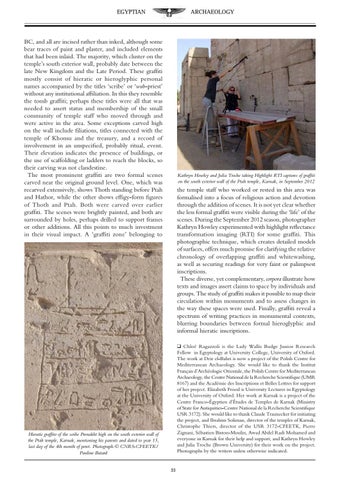
BC, and all are incised rather than inked, although some bear traces of paint and plaster, and included elements that had been inlaid. The majority, which cluster on the temple’s south exterior wall, probably date between the late New Kingdom and the Late Period. These graffiti mostly consist of hieratic or hieroglyphic personal names accompanied by the titles ‘scribe’ or ‘wab-priest’ without any institutional affiliation. In this they resemble the tomb graffiti; perhaps these titles were all that was needed to assert status and membership of the small community of temple staff who moved through and were active in the area. Some exceptions carved high on the wall include filiations, titles connected with the temple of Khonsu and the treasury, and a record of involvement in an unspecified, probably ritual, event. Their elevation indicates the presence of buildings, or the use of scaffolding or ladders to reach the blocks, so their carving was not clandestine. The most prominent graffiti are two formal scenes carved near the original ground level. One, which was recarved extensively, shows Thoth standing before Ptah and Hathor, while the other shows effigy-form figures of Thoth and Ptah. Both were carved over earlier graffiti. The scenes were brightly painted, and both are surrounded by holes, perhaps drilled to support frames or other additions. All this points to much investment in their visual impact. A ‘graffiti zone’ belonging to
Kathryn Howley and Julia Troche taking Highlight RTI captures of graffiti on the south exterior wall of the Ptah temple, Karnak, in September 2012
the temple staff who worked or rested in this area was formalised into a focus of religious action and devotion through the addition of scenes. It is not yet clear whether the less formal graffiti were visible during the ‘life’ of the scenes. During the September 2012 season, photographer Kathryn Howley experimented with highlight reflectance transformation imaging (RTI) for some graffiti. This photographic technique, which creates detailed models of surfaces, offers much promise for clarifying the relative chronology of overlapping graffiti and whitewashing, as well as securing readings for very faint or palimpsest inscriptions. These diverse, yet complementary, corpora illustrate how texts and images assert claims to space by individuals and groups. The study of graffiti makes it possible to map their circulation within monuments and to assess changes in the way these spaces were used. Finally, graffiti reveal a spectrum of writing practices in monumental contexts, blurring boundaries between formal hieroglyphic and informal hieratic inscriptions. q Chloé Ragazzoli is the Lady Wallis Budge Junior Research Fellow in Egyptology at University College, University of Oxford. The work at Deir el-Bahri is now a project of the Polish Centre for Mediterranean Archaeology. She would like to thank the Institut Français d’Archéologie Orientale, the Polish Centre for Mediterranean Archaeology, the Centre National de la Recherche Scientifique (UMR 8167) and the Académie des Inscriptions et Belles Lettres for support of her project. Elizabeth Frood is University Lecturer in Egyptology at the University of Oxford. Her work at Karnak is a project of the Centre Franco-Égyptien d’Études de Temples de Karnak (Ministry of State for Antiquities-Centre National de la Recherche Scientifique USR 3172). She would like to thank Claude Traunecker for initiating the project, and Ibrahim Soliman, director of the temples of Karnak, Christophe Thiers, director of the USR 3172-CFEETK, Pierre Zignani, Sébastien Biston-Moulin, Awad Abdel Radi Mohamed and everyone in Karnak for their help and support, and Kathryn Howley and Julia Troche (Brown University) for their work on the project. Photographs by the writers unless otherwise indicated.
Hieratic graffito of the scribe Prenakht high on the south exterior wall of the Ptah temple, Karnak, mentioning his parents and dated to year 15, last day of the 4th month of peret. Photograph:© CNRS-CFEETK/ Pauline Batard 33