EGYPTIAN
ARCHAEOLOGY
types, signatures, and funerary offerings, in addition to the erotica. Many visitors signed their graffiti with their titles, which show that most of them belonged to the staff of the nearby funerary temples of Tuthmosis I, Hatshepsut and Tuthmosis III. These men may have appropriated this place because of its pleasant view across the valley and the shade and fresh breezes it provided. Although it might seem surprising to find prayers and offerings together with more secular drawings, the ensemble shows how graffiti can display the interests and preoccupations of a
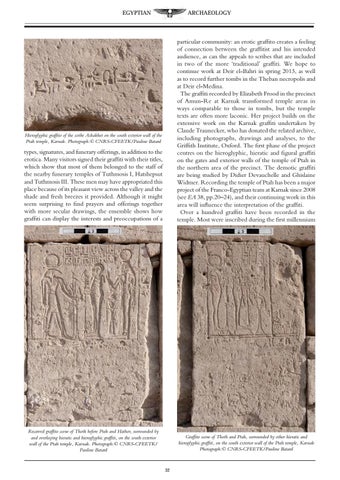
particular community: an erotic graffito creates a feeling of connection between the graffitist and his intended audience, as can the appeals to scribes that are included in two of the more ‘traditional’ graffiti. We hope to continue work at Deir el-Bahri in spring 2013, as well as to record further tombs in the Theban necropolis and at Deir el-Medina. The graffiti recorded by Elizabeth Frood in the precinct of Amun-Re at Karnak transformed temple areas in ways comparable to those in tombs, but the temple texts are often more laconic. Her project builds on the extensive work on the Karnak graffiti undertaken by Claude Traunecker, who has donated the related archive, including photographs, drawings and analyses, to the Griffith Institute, Oxford. The first phase of the project centres on the hieroglyphic, hieratic and figural graffiti on the gates and exterior walls of the temple of Ptah in the northern area of the precinct. The demotic graffiti are being studied by Didier Devauchelle and Ghislaine Widmer. Recording the temple of Ptah has been a major project of the Franco-Egyptian team at Karnak since 2008 (see EA 38, pp.20–24), and their continuing work in this area will influence the interpretation of the graffiti. Over a hundred graffiti have been recorded in the temple. Most were inscribed during the first millennium
Recarved graffito scene of Thoth before Ptah and Hathor, surrounded by and overlaying hieratic and hieroglyphic graffiti, on the south exterior wall of the Ptah temple, Karnak. Photograph:© CNRS-CFEETK/ Pauline Batard
Graffito scene of Thoth and Ptah, surrounded by other hieratic and hieroglyphic graffiti, on the south exterior wall of the Ptah temple, Karnak Photograph:© CNRS-CFEETK/Pauline Batard
Hieroglyphic graffito of the scribe Ashakhet on the south exterior wall of the Ptah temple, Karnak. Photograph:© CNRS-CFEETK/Pauline Batard
32