EGYPTIAN
ARCHAEOLOGY
Tomb of Antefiqer, corridor, north wall, scene of fowling and fishing: visitors inked their graffiti between the legs of the three fishermen
Tomb of Antefiqer, corridor, south wall, scene of pilgrimage to Abydos: the graffiti are inked at the stern of Antefiqer’s boat
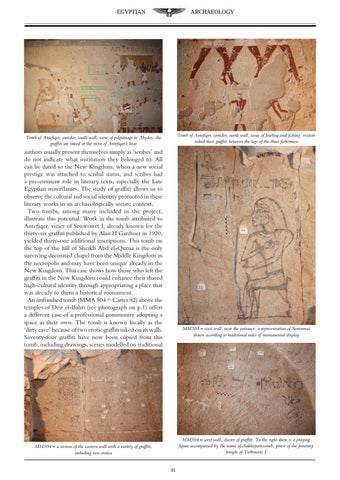
authors usually present themselves simply as ‘scribes’ and do not indicate what institution they belonged to. All can be dated to the New Kingdom, when a new social prestige was attached to scribal status, and scribes had a pre-eminent role in literary texts, especially the Late Egyptian miscellanies. The study of graffiti allows us to observe the cultural and social identity promoted in these literary works in an archaeologically secure context. Two tombs, among many included in the project, illustrate this potential. Work in the tomb attributed to Antefiqer, vizier of Senwosret I, already known for the thirty-six graffiti published by Alan H Gardiner in 1920, yielded thirty-one additional inscriptions. This tomb on the top of the hill of Sheikh Abd el-Qurna is the only surviving decorated chapel from the Middle Kingdom in the necropolis and may have been unique already in the New Kingdom. This case shows how those who left the graffiti in the New Kingdom could enhance their shared high-cultural identity through appropriating a place that was already to them a historical monument. An unfinished tomb (MMA 504 = Carter 82) above the temples of Deir el-Bahri (see photograph on p.1) offers a different case of a professional community adopting a space as their own. The tomb is known locally as the ‘dirty cave’ because of two erotic graffiti inked on its walls. Seventy-four graffiti have now been copied from this tomb, including drawings, scenes modelled on traditional
MM504 – west wall, near the entrance: a representation of Senenmut drawn according to traditional rules of monumental display
MM504 – west wall, cluster of graffiti. To the right there is a praying figure accompanied by the name of Aakheperresoneb, priest of the funerary temple of Tuthmosis I
MM504 – a section of the eastern wall with a variety of graffiti, including two erotica 31