EGYPTIAN
ARCHAEOLOGY
Writing on the wall: two graffiti projects in Luxor At an EES Seminar in June 2012 (available to view at: www.ustream.tv/recorded/23505099) Chloé Ragazzoli and Elizabeth Frood presented their work on the study of ancient graffiti. Here they describe their respective research projects in Theban tombs and at the temple of Ptah at Karnak. Ancient graffiti practices are very distant from modern stereotypes of furtive, subversive scribblings and vandalism. In antiquity, literacy was an elite privilege and writing on the wall was an accepted way to fashion and display one’s identity.The study of ancient graffiti, a rapidly developing area of research, offers a range of insights into the meaning, development, and appropriation of space. Leaving one’s name in a place is a way to appropriate it. For example, Egyptians carved thousands of graffiti along desert expedition routes and in mining and quarry sites, laying claim to strategic places that were at the margins of their political and cultural control. Comparable practices existed in built environments such as temples and tombs. Two projects in Luxor - in Theban tombs and in the temple complex of Karnak - study how graffiti created ‘contact zones’ in which social groups presented crucial aspects of their identity. The use and meaning of graffiti also changed over time, as did the use and perception of the spaces in which they were inscribed. Visitors’ inscriptions in Theban tombs are ink graffiti (also called dipinti) that were left by those who ‘came to see the tomb’, to quote the texts themselves. Current work
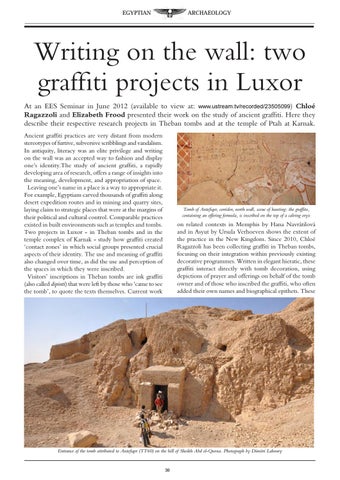
Tomb of Antefiqer, corridor, north wall, scene of hunting: the graffito, containing an offering formula, is inscribed on the top of a calving oryx
on related contexts in Memphis by Hana Navrátilová and in Asyut by Ursula Verhoeven shows the extent of the practice in the New Kingdom. Since 2010, Chloé Ragazzoli has been collecting graffiti in Theban tombs, focusing on their integration within previously existing decorative programmes. Written in elegant hieratic, these graffiti interact directly with tomb decoration, using depictions of prayer and offerings on behalf of the tomb owner and of those who inscribed the graffiti, who often added their own names and biographical epithets. These
Entrance of the tomb attributed to Antefiqer (TT60) on the hill of Sheikh Abd el-Qurna. Photograph by Dimitri Laboury 30