EGYPTIAN
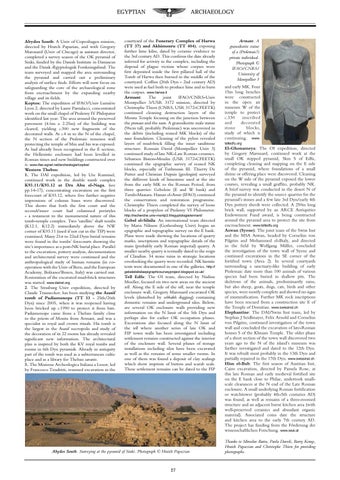
Abydos South: A Univ of Copenhagen mission, directed by Hratch Papazian, and with Gregory Marouard (Univ of Chicago) as assistant director, completed a survey season of the OK pyramid of Sinki, funded by the Danish Institute in Damascus and the Dansk Ægyptologisk Forskningsfond. The team surveyed and mapped the area surrounding the pyramid and carried out a preliminary analysis of surface finds. Efforts will now focus on safeguarding the core of the archaeological zone from encroachment by the expanding nearby village and its fields. Koptos: The expedition of IFAO/Univ Lumière Lyon 2, directed by Laure Pantalacci, concentrated work on the small chapel of Ptolemy IV Philopator identified last year. The area around the preserved pavement (4.6m x 2.25m) of the building was cleared, yielding c.300 new fragments of the decorated walls. At c.4 m to the N of the chapel, the N section of the Ptolemaic temenos wall protecting the temple of Min and Isis was exposed. As had already been recognised in the E section, the Hellenistic enclosure had been levelled in Roman times and new buildings constructed over it. www.ifao.egnet.net/archeologie/coptos/ Western Thebes: 1. The DAI expedition, led by Ute Rummel, continued work in the double tomb complex K93.11/K93.12 at Dra Abu el-Naga, (see pp.14-17), concentrating excavation on the first forecourt of K93.12, where five further negative impressions of column bases were discovered. This shows that both the first court and the second/inner court had columned peristyles - a testament to the monumental nature of this tomb-temple complex. Two ‘satellite’ shaft tombs (K12.1, K12.2) immediately above the NW corner of K93.11 (used if not cut in the TIP) were examined. Many 21st to 22nd Dyns burial remains were found in the tombs’ forecourts showing the site’s importance as a post-NK burial place. Parallel to the excavation, pottery analysis, documentation and architectural survey were continued and the anthropological study of human remains (in cooperation with the Univ of Bern, and the European Academy, Bolzano/Bozen, Italy) was carried out. Restoration of the excavated mud-brick structures was started. www.dainst.org 2. The Strasburg Univ expedition, directed by Claude Traunecker, has been studying the Asasif tomb of Padiamenope (TT 33 - 25th/26th Dyn) since 2005, when it was reopened having been bricked up c.1990 to protect it from bats. Padiamenope came from a Theban family close to the priests of Montu from Armant, and was a specialist in royal and crown rituals. His tomb is the largest in the Asasif necropolis and study of the decoration of its 22 rooms has already revealed significant new information. The architectural plan is inspired by both the KV royal tombs and rooms in 6th Dyn pyramids. Already in antiquity part of the tomb was used as a subterranean cultic place and as a library for Theban savants. 3. The Missione Archeologica Italiana a Luxor, led by Francesco Tiradritti, resumed excavation in the
ARCHAEOLOGY
courtyard of the Funerary Complex of Harwa (TT 37) and Akhimenru (TT 404), exposing further lime kilns, dated by ceramic evidence to the 3rd century AD. This confirms the date already inferred for activity in the complex, including the disposal of plague victims whose corpses were first deposited inside the first pillared hall of the Tomb of Harwa then burned in the middle of the courtyard. Coffins (26th Dyn - 2nd century AD) were used as fuel both to produce lime and to burn the corpses. www.harwa.it Armant: The joint IFAO/CNRS-Univ Montpellier 3/USR 3172 mission, directed by Christophe Thiers (CNRS, USR 3172-CFEETK) continued cleaning destruction layers of the Montu Temple focusing on the junction between the pronaos and the naos. A granodiorite male statue (96cm tall, probably Ptolemaic) was uncovered in the debris (including reused MK blocks) of the naos foundation. Cleaning of the pylon revealed layers of mud-brick filling the inner sandstone structure. Romain David (Montpellier Univ 3) continued study of late NK-Late Roman ceramics. Sébastien Biston-Moulin (USR 3172-CFEETK) continued the epigraphic survey of reused NK blocks, especially of Tuthmosis III. Thierry De Putter and Christian Dupuis (geologist) surveyed the different kinds of limestone used at the site from the early MK to the Roman Period, from three quarries: Gebelein (E and W bank) and Turah-Maasara. Hassan el-Amir (IFAO) continued the conservation and restoration programme. Christophe Thiers completed the survey of loose blocks of a propylon of Ptolemy VI Philometor. http://recherche.univ-montp3.fr/egyptologie/ermant/
Gebel el-Silsila: An international team directed by Maria Nilsson (Gothenburg Univ) began an epigraphic and topographic survey on the E bank. Plans were made showing the locations of quarry marks, inscriptions and topographic details of the main (probably early Roman imperial) quarry. A smaller nearby quarry is textually dated to the reign of Claudius. 54 stone ruins in strategic locations overlooking the quarry were recorded. NK hieratic texts were documented in one of the galleries. http:// gebelelsilsilaepigraphicsurveyproject.blogspot.co.uk/
Tell Edfu: The OI team, directed by Nadine Moeller, focused on two new areas on the ancient tell. Along the E side of the tell, near the temple enclosure wall, Gregory Marouard excavated OK levels (disturbed by sebbakh digging) containing domestic remains and underground silos. Below, are several OK enclosure walls providing new information on the N limit of the 5th Dyn and perhaps also for earlier OK occupation phases. Excavations also focused along the N limit of the tell where another series of late OK and FIP town walls has been investigated including settlement remains constructed against the interior of the enclosure wall. Several phases of storage installations including silos have been excavated as well as the remains of some smaller rooms. In one of them was found a deposit of clay sealings which show imprints of button and scarab seals. These settlement remains can be dated to the FIP
Abydos South. Surveying at the pyramid of Sinki. Photograph © Hratch Papazian
27
Armant. A granodiorite statue of a (Ptolemaic?) private individual. Photograph © IFAO/CNRS/ University of Montpellier 3 and early MK. Four 15m long benches were constructed in the open air museum W of the temple to protect c.330 inscribed and decorated stone blocks, study of which is continuing. www. telledfu.org
El-Ghonameya: The OI expedition, directed by Gregory Marouard, continued work at the small OK stepped pyramid, 5km S of Edfu, completing cleaning and mapping on the E side of the pyramid, where foundations of a small shrine or offering place were discovered. Cleaning on the W side of the pyramid exposed the lower courses, revealing a small graffito, probably NK. A brief survey was conducted in the desert N of the pyramid to identify the source quarries for the pyramid’s stones and a few late 3rd Dyn/early 4th Dyn pottery sherds were collected. A 250m long brick wall, supported by an ARCE Antiquities Endowment Fund award, is being constructed around the pyramid area to protect the site from encroachment. www.telledfu.org Aswan (Syene): The joint team of the Swiss Inst and the MSA Aswan, headed by Cornelius von Pilgrim and Mohammed el-Bialy, and directed in the field by Wolfgang Müller, concluded the investigation of the town wall of Syene and continued excavations in the SE corner of the fortified town (Area 2). In several courtyards surrounding a sanctuary-like building of early Ptolemaic date more than 100 animals of various species had been buried in shallow pits. The skeletons of the animals, predominantly rams, but also sheep, goats, dogs, cats, birds and other species, were mostly complete and showed no signs of mummification. Further MK rock inscriptions have been rescued from a construction site E of the Temple of Domitian. www.swissinst.ch Elephantine: The DAI/Swiss Inst team, led by Stephan J Seidlmayer, Felix Arnold and Cornelius von Pilgrim, continued investigation of the town wall and concluded the excavation of late-Roman houses S of the Khnum Temple. The older phase of a short section of the town wall discovered two years ago to the N of the island’s museum was further investigated and dated to the 12th Dyn. It was rebuilt most probably in the 13th Dyn and partially repaired in the 17th Dyn. www.swissinst.ch Hisn el-Bab: The first season of Austrian Inst, Cairo excavation, directed by Pamela Rose, at this late Roman and early medieval fortified site on the E bank close to Philae, undertook smallscale clearances at the N end of the Late Roman enclosure. A small underlying Roman fortification or watchtower (probably 4th-5th centuries AD) was found, as well as remains of a three-roomed structure and an adjacent burnt kitchen area (with well-preserved ceramics and abundant organic material). Associated coins date the structure and kitchen area to the early 7th century AD. The project has funding from the Förderung der wissenschaftlichen Forschung. www.oeai.at Thanks to Miroslav Barta, Paola Davoli, Barry Kemp, Hratch Papazian and Christophe Thiers for providing photographs.