EGYPTIAN
ARCHAEOLOGY
Digging Diary 2012 Summaries of some of the archaeological work undertaken in Egypt during 2012 appear below. The sites are arranged geographically from north to south. Field Directors who would like reports on their work to appear in EA are asked to e-mail a short summary, with a website address if available, as soon as possible after the end of each season to: patricia. spencer@ees.ac.uk PATRICIA SPENCER Abbreviations: ED Early Dynastic; OK Old Kingdom; FIP First Intermediate Period; MK Middle Kingdom; SIP Second Intermediate Period; NK New Kingdom; TIP Third Intermediate Period; LP Late Period; GR Graeco-Roman. Institutions and Research Centres: ARCE American Research Center in Egypt; BM British Museum, London; CFEETK Franco-Egyptian Centre, Karnak; CNRS French National Research Centre; DAI German Archaeological Institute, Cairo; FNRS National Fund for Scientific Research, Brussels; IFAO French Institute, Cairo; MMA Metropolitan Museum of Art, New York; MSA Ministry of State for Antiquities, Egypt; OI Oriental Institute, University of Chicago; SCA Supreme Council for Antiquities, Egypt; Swiss Inst Swiss Institute for Architectural Research and Archaeology, Cairo; UMR, USR research groups of the CNRS. SUMMER 2012 (May to September) Lower Egypt Buto: The Univ of Poitiers team, led by Pascale Ballet and in cooperation with the DAI, continued excavation of the bath complex (see EA 40, p.16) on the ‘English Kom’, identifying the remains of the cistern where the water used in the bath was stored and establishing the E limit of the Roman bath. Surveys on Kom A followed the testing in spring 2012 of a new method of extensive survey and mapping on an area of over 11,000 sq m. A first aim of the survey is to establish, for the Kom A area initially, the limits of the late (LP to the beginning of the Islamic Period) phases of occupation of the town. Material excavated previously in squares P5, P6, P7, P9 and P11 was studied. http://herma.labo. univ-poitiers.fr/spip.php?article186/
Tell el-Ruba (Mendes): The Pennsylvania State Univ expedition, directed by Susan and Donald Redford, continued work on Temple T, c.110m due
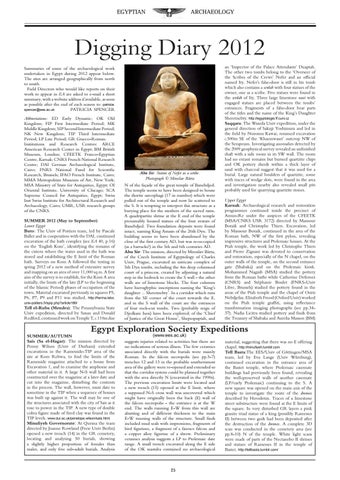
Abu Sir. Statue of Nefer as a scribe. Photograph © Miroslav Bárta N of the façade of the great temple of Banebdjed. The temple seems to have been designed to house the diorite sarcophagi (17 in number) which were pulled out of the temple and now lie scattered to the S. It is tempting to interpret this structure as a burying place for the mothers of the sacred rams. A quadripartite shrine at the E end of the temple presumably housed statues of the four avatars of Banebdjed. Two foundation deposits were found intact, naming King Amasis of the 26th Dyn. The building seems to have been abandoned by the close of the first century AD, but was re-occupied (as a barracks?) in the 5th and 6th centuries AD. Abu Sir: The mission, directed by Miroslav Bárta, of the Czech Institute of Egyptology of Charles Univ, Prague, excavated an intricate complex of 5th Dyn tombs, including the 4m deep columned court of a princess, created by adjusting a natural step in the bedrock to create the S wall - the other walls are of limestone blocks. The four columns have hieroglyphic inscriptions naming the ‘King’s daughter ... Sheretnebty’. In a corridor which runs from the SE corner of the court towards the E, and in the S wall of the court are the entrances of four rock-cut tombs. Two (probably reign of Djedkare Isesi) have been explored; of the ‘Chief of Justice of the Great House’, Shepespuptah, and
an ‘Inspector of the Palace Attendants’ Duaptah. The other two tombs belong to the ‘Overseer of the Scribes of the Crews’ Nefer and an official named Ity. Nefer’s false-door is still in his tomb which also contains a serdab with four statues of the owner, one as a scribe. Five statues were found in the serdab of Ity. Three large limestone naoi with engaged statues are placed between the tombs’ entrances. Fragments of a false-door bear parts of the titles and the name of the King’s Daughter Sheretnebty. http://egyptologie.ff.cuni.cz Saqqara: The Waseda Univ expedition, under the general direction of Sakuji Yoshimura and led in the field by Nozomu Kawai, resumed excavation c.500m SE of the ‘Khaemwaset’ outcrop NW of the Serapeum. Investigating anomalies detected by the 2009 geophysical survey revealed an unfinished shaft with a side room in its SW wall. The room had no extant remains but burned quartzite chips and OK pottery sherds within a thick layer of sand with charcoal suggest that it was used for a burial. Large natural boulders of quartzite, some with traces of wedge slots, were found in the area and investigation nearby also revealed small pits probably used for quarrying quartzite stones. Upper Egypt Karnak: Archaeological research and restoration programmes continued inside the precinct of Amun-Re under the auspices of the CFEETK (MSA/CNRS USR 3172) directed by Mansour Boraik and Christophe Thiers. Excavation, led by Mansour Boraik, continued in the area of the Roman bath, NW of the first pylon, revealing impressive structures and Ptolemaic houses. At the Ptah temple, the work led by Christophe Thiers and Pierre Zignani was devoted to conservation and restoration, especially of the N chapel, on the outer walls of the temple, on the second entrance gate (Shabaka) and on the Ptolemaic kiosk. Mohammed Naguib (MSA) studied the pottery from the Roman baths while Catherine Defernez (CNRS) and Stéphanie Boulet (FNRS-Univ Libre, Brussels) studied the pottery found in the areas of the Ptah temple and the chapel of Osiris Nebdjefau. Elizabeth Frood (Oxford Univ) worked on the Ptah temple graffiti, using reflectance transformation imaging photographs (see pp.3437). Nadia Licitra studied pottery and finds from the Treasury of Shabaka and Aurelia Masson (BM)
Egypt Exploration Society Expeditions
SUMMER/AUTUMN Sais (Sa el-Hagar): The mission directed by Penny Wilson (Univ of Durham) extended excavations in the Ramesside-TIP area of the site at Kom Rebwa, to find the limits of the Ramesside magazine attached to a house from Excavation 1, and to examine the amphorae and other material in it. A large N-S wall had been constructed over the magazine at a later date and cut into the magazine, disturbing the contents in the process. The wall, however, must date to sometime in the TIP when a sequence of houses was built up against it. The wall may be one of the structures associated with the city of Sais as it rose to power in the TIP. A new type of double cobra figure made of fired clay was found in the TIP levels. www.dur.ac.uk/penelope.wilson/sais.html. Minufiyeh Governorate: At Quesna the team directed by Joanne Rowland (Freie Univ Berlin) opened a new trench (14) in the GR cemetery, locating and analysing 50 burials, showing a slightly higher proportion of females than males, and only five sub-adult burials. Analysis
(www.ees.ac.uk) suggests injuries related to activities but there are no indications of serious illness. The few ceramics associated directly with the burials were mainly Roman. In the falcon necropolis (see pp.5-7) trenches 12 and 13 in the probable southernmost area of the gallery were re-opened and extended so that the corridor system could be planned together with the area directly N (excavated in the 1990s). The previous excavation limits were located and a new trench (15) opened at the E limit, where a supposed N-S cross wall was uncovered which might have originally been the back (E) wall of the falcon necropolis - the entrance is at the W end. The walls running E-W from this wall are abutting and of different thickness to the main E-W running walls of the structure. Small finds included mud seals with impressions, fragments of bird figurines, a fragment of a faience falcon and a copper alloy figurine of a shrew. Preliminary ceramics analysis suggests a LP to Ptolemaic date range. A small trench excavated along the E side of the OK mastaba contained no archaeological
25
material, suggesting that there was no E offering chapel. http://minufiyeh.tumblr.com Tell Basta:The EES/Univ of Göttingen/MSA team, led by Eva Lange (Univ Würzburg), continued excavation in the entrance area of the Bastet temple, where Ptolemaic casemate buildings had previously been found, revealing the well-preserved walls of another casemate (LP/early Ptolemaic) continuing to the S. A new square was opened on the main axis of the temple to investigate the route of the dromos described by Herodotus. Traces of a limestone street substructure were found at the E limits of the square. In very disturbed GR layers a pink granite triad statue of a king (possibly Ramesses II) between two gods had been deposited after the destruction of the dromos. A complete 3D scan was conducted in the cemetery area (see pp.8-10) N of the temple. White light scans were made of parts of the Nectanebo II shrines and statues of Ramesses II in the temple of Bastet. http://tellbasta.tumblr.com/