EGYPTIAN
ARCHAEOLOGY
Chapter BD 149, the list of the fourteen mounds of the Netherworld, is written in the lower register of the walls to be spatially closer to the underworld, revealing a meaningful location for at least some of the chapters, an intention that can also be appreciated on the ceiling. The original area of the ceiling was divided into five registers. After BD 42, which includes the division of the body into eighteen parts from top to bottom, come the chapters concerning the ‘knowing the souls/powers’ of the holy towns of Hermopolis, Pe and Nekhen, and the Westerners and Easterners in the sky (BD 114-112113-108-109). Following them is BD 125, in which the deceased enters the Hall of Justice. BD 125 tends to be written towards the end on papyri, while here it occupies the most important spot in the chamber, the middle register of the ceiling, on both sides of the large size central figure of the goddess Nut. As far as we can tell, the burial chamber of Djehuty is one of the earliest preserved compilations of the Book of the Dead that includes this chapter, which soon after would become very popular. The figure of the night sky goddess Nut (see front cover), wearing a tight dark blue dress, takes up the very central part of the ceiling. She has her arms raised and stretched open in a protective pose, as if embracing Djehuty’s coffin and mummy lying beneath her. The texts at either side of her body express Djehuty’s wish that this situation will actually happen: (A) Words spoken by the overseer of the Treasury of the King, Djehuty: ‘[Oh mother] Nut, spread yourself over me, may you place me among the imperishable stars which are in you, as I shall not die. (B) Raise me up. I am your son. Remove the weariness from me. Protect me from he who shall act against me. These two brief petitions are written on a yellow background and are not retrograde. In fact, they are not taken from the Book of the Dead (written here on a white background), but from formulae written on coffins, as is also the case for the embracing figure of Nut. The number of scribal mistakes would indicate that the text was written in haste. The loose brush strokes with which the vignettes’ figures were depicted - the lack of
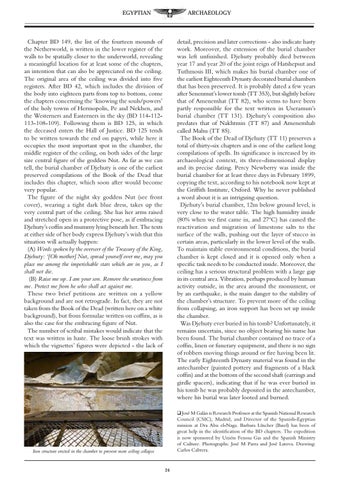
detail, precision and later corrections - also indicate hasty work. Moreover, the extension of the burial chamber was left unfinished. Djehuty probably died between year 17 and year 20 of the joint reign of Hatshepsut and Tuthmosis III, which makes his burial chamber one of the earliest Eighteenth Dynasty decorated burial chambers that has been preserved. It is probably dated a few years after Senenmut’s lower tomb (TT 353), but slightly before that of Amenemhat (TT 82), who seems to have been partly responsible for the text written in Useramun’s burial chamber (TT 131). Djehuty’s composition also predates that of Nakhtmin (TT 87) and Amenemhab called Mahu (TT 85). The Book of the Dead of Djehuty (TT 11) preserves a total of thirty-six chapters and is one of the earliest long compilations of spells. Its significance is increased by its archaeological context, its three-dimensional display and its precise dating. Percy Newberry was inside the burial chamber for at least three days in February 1899, copying the text, according to his notebook now kept at the Griffith Institute, Oxford. Why he never published a word about it is an intriguing question. Djehuty’s burial chamber, 12m below ground level, is very close to the water table. The high humidity inside (80% when we first came in, and 27ºC) has caused the reactivation and migration of limestone salts to the surface of the walls, pushing out the layer of stucco in certain areas, particularly in the lower level of the walls. To maintain stable environmental conditions, the burial chamber is kept closed and it is opened only when a specific task needs to be conducted inside. Moreover, the ceiling has a serious structural problem with a large gap in its central area. Vibration, perhaps produced by human activity outside, in the area around the monument, or by an earthquake, is the main danger to the stability of the chamber’s structure. To prevent more of the ceiling from collapsing, an iron support has been set up inside the chamber. Was Djehuty ever buried in his tomb? Unfortunately, it remains uncertain, since no object bearing his name has been found. The burial chamber contained no trace of a coffin, linen or funerary equipment, and there is no sign of robbers moving things around or fire having been lit. The early Eighteenth Dynasty material was found in the antechamber (painted pottery and fragments of a black coffin) and at the bottom of the second shaft (earrings and girdle spacers), indicating that if he was ever buried in his tomb he was probably deposited in the antechamber, where his burial was later looted and burned. q José M Galán is Research Professor at the Spanish National Research Council (CSIC), Madrid, and Director of the Spanish-Egyptian mission at Dra Abu el-Naga. Barbara Lüscher (Basel) has been of great help in the identification of the BD chapters. The expedition is now sponsored by Unión Fenosa Gas and the Spanish Ministry of Culture. Photographs: José M Parra and José Latova. Drawing: Carlos Cabrera.
Iron structure erected in the chamber to prevent more ceiling collapse 24