EGYPTIAN
ARCHAEOLOGY
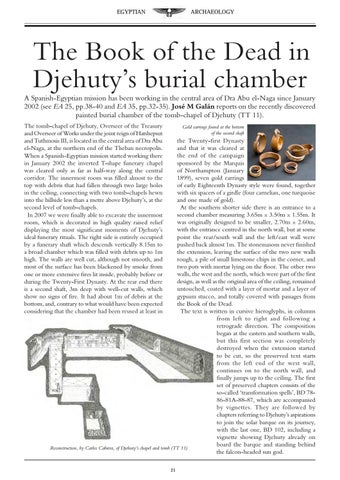
The Book of the Dead in Djehuty’s burial chamber A Spanish-Egyptian mission has been working in the central area of Dra Abu el-Naga since January 2002 (see EA 25, pp.38-40 and EA 35, pp.32-35). José M Galán reports on the recently discovered painted burial chamber of the tomb-chapel of Djehuty (TT 11). The tomb-chapel of Djehuty, Overseer of the Treasury and Overseer of Works under the joint reign of Hatshepsut and Tuthmosis III, is located in the central area of Dra Abu el-Naga, at the northern end of the Theban necropolis. When a Spanish-Egyptian mission started working there in January 2002 the inverted T-shape funerary chapel was cleared only as far as half-way along the central corridor. The innermost room was filled almost to the top with debris that had fallen through two large holes in the ceiling, connecting with two tomb-chapels hewn into the hillside less than a metre above Djehuty’s, at the second level of tomb-chapels. In 2007 we were finally able to excavate the innermost room, which is decorated in high quality raised relief displaying the most significant moments of Djehuty’s ideal funerary rituals. The right side is entirely occupied by a funerary shaft which descends vertically 8.15m to a broad chamber which was filled with debris up to 1m high. The walls are well cut, although not smooth, and most of the surface has been blackened by smoke from one or more extensive fires lit inside, probably before or during the Twenty-First Dynasty. At the rear end there is a second shaft, 3m deep with well-cut walls, which show no signs of fire. It had about 1m of debris at the bottom, and, contrary to what would have been expected considering that the chamber had been reused at least in
Gold earrings found at the bottom of the second shaft
the Twenty-first Dynasty and that it was cleared at the end of the campaign sponsored by the Marquis of Northampton (January 1899), seven gold earrings of early Eighteenth Dynasty style were found, together with six spacers of a girdle (four carnelian, one turquoise and one made of gold). At the southern shorter side there is an entrance to a second chamber measuring 3.65m x 3.50m x 1.55m. It was originally designed to be smaller, 2.70m x 2.60m, with the entrance centred in the north wall, but at some point the rear/south wall and the left/east wall were pushed back almost 1m. The stonemasons never finished the extension, leaving the surface of the two new walls rough, a pile of small limestone chips in the corner, and two pots with mortar lying on the floor. The other two walls, the west and the north, which were part of the first design, as well as the original area of the ceiling, remained untouched, coated with a layer of mortar and a layer of gypsum stucco, and totally covered with passages from the Book of the Dead. The text is written in cursive hieroglyphs, in columns from left to right and following a retrograde direction. The composition began at the eastern and southern walls, but this first section was completely destroyed when the extension started to be cut, so the preserved text starts from the left end of the west wall, continues on to the north wall, and finally jumps up to the ceiling. The first set of preserved chapters consists of the so-called ‘transformation spells’, BD 7886-81A-88-87, which are accompanied by vignettes. They are followed by chapters referring to Djehuty’s aspirations to join the solar barque on its journey, with the last one, BD 102, including a vignette showing Djehuty already on board the barque and standing behind Reconstruction, by Carlos Cabrera, of Djehuty’s chapel and tomb (TT 11) the falcon-headed sun god. 21