EGYPTIAN
ARCHAEOLOGY
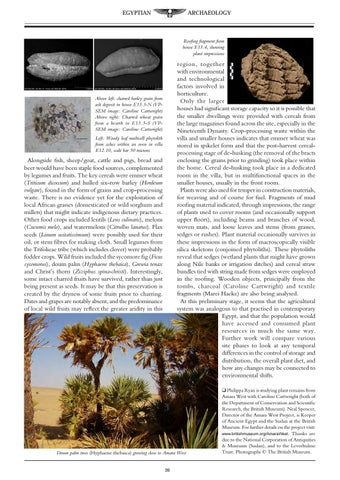
Roofing fragment from house E13.4, showing plant impressions
region, together with environmental and technological factors involved in horticulture. Only the larger houses had significant storage capacity so it is possible that the smaller dwellings were provided with cereals from the large magazines found across the site, especially in the Nineteenth Dynasty. Crop-processing waste within the villa and smaller houses indicates that emmer wheat was stored in spikelet form and that the post-harvest cerealprocessing stage of de-husking (the removal of the bracts enclosing the grains prior to grinding) took place within the home. Cereal de-husking took place in a dedicated room in the villa, but in multifunctional spaces in the smaller houses, usually in the front room. Plants were also used for temper in construction materials, for weaving and of course for fuel. Fragments of mud roofing material indicated, through impressions, the range of plants used to cover rooms (and occasionally support upper floors), including beams and branches of wood, woven mats, and loose leaves and stems (from grasses, sedges or rushes). Plant material occasionally survives in these impressions in the form of macroscopically visible silica skeletons (conjoined phytoliths). These phytoliths reveal that sedges (wetland plants that might have grown along Nile banks or irrigation ditches) and cereal straw bundles tied with string made from sedges were employed in the roofing. Wooden objects, principally from the tombs, charcoal (Caroline Cartwright) and textile fragments (Marei Hacke) are also being analysed. At this preliminary stage, it seems that the agricultural system was analogous to that practised in contemporary Egypt, and that the population would have accessed and consumed plant resources in much the same way. Further work will compare various site phases to look at any temporal differences in the control of storage and distribution, the overall plant diet, and how any changes may be connected to environmental shifts.
Above left: charred barley grain from ash deposit in house E13.3-N (VPSEM image: Caroline Cartwright) Above right: Charred wheat grain from a hearth in E13.3-S (VPSEM image: Caroline Cartwright) Left: Woody leaf multicell phytolith from ashes within an oven in villa E12.10, scale bar 50 microns
Alongside fish, sheep/goat, cattle and pigs, bread and beer would have been staple food sources, complemented by legumes and fruits. The key cereals were emmer wheat (Triticum dicoccum) and hulled six-row barley (Hordeum vulgare), found in the form of grains and crop-processing waste. There is no evidence yet for the exploitation of local African grasses (domesticated or wild sorghum and millets) that might indicate indigenous dietary practices. Other food crops included lentils (Lens culinaris), melons (Cucumis melo), and watermelons (Citrullus lanatus). Flax seeds (Linum usitatissimum) were possibly used for their oil, or stem fibres for making cloth. Small legumes from the Trifolieae tribe (which includes clover) were probably fodder crops. Wild fruits included the sycomore fig (Ficus sycomorus), doum palm (Hyphaene thebaica), Grewia tenax and Christ’s thorn (Ziziphus spina-christi). Interestingly, some intact charred fruits have survived, rather than just being present as seeds. It may be that this preservation is created by the dryness of some fruits prior to charring. Dates and grapes are notably absent, and the predominance of local wild fruits may reflect the greater aridity in this
Doum palm trees (Hyphaene thebaica) growing close to Amara West 20
q Philippa Ryan is studying plant remains from Amara West with Caroline Cartwright (both of the Department of Conservation and Scientific Research, the British Museum). Neal Spencer, Director of the Amara West Project, is Keeper of Ancient Egypt and the Sudan at the British Museum. For further details on the project visit: www.britishmuseum.org/AmaraWest. Thanks are due to the National Corporation of Antiquities & Museums (Sudan), and to the Leverhulme Trust. Photographs Š The British Museum.