EGYPTIAN
ARCHAEOLOGY
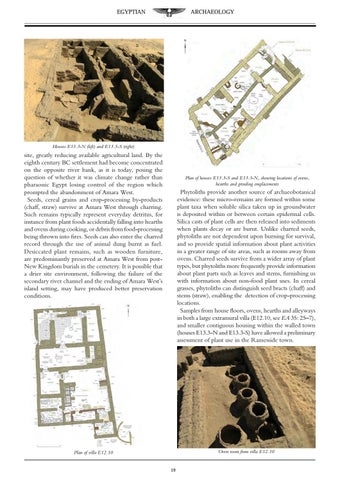
Houses E13.3-N (left) and E13.3-S (right)
site, greatly reducing available agricultural land. By the eighth century BC settlement had become concentrated on the opposite river bank, as it is today, posing the question of whether it was climate change rather than pharaonic Egypt losing control of the region which prompted the abandonment of Amara West. Seeds, cereal grains and crop-processing by-products (chaff, straw) survive at Amara West through charring. Such remains typically represent everyday detritus, for instance from plant foods accidentally falling into hearths and ovens during cooking, or debris from food-processing being thrown into fires. Seeds can also enter the charred record through the use of animal dung burnt as fuel. Desiccated plant remains, such as wooden furniture, are predominantly preserved at Amara West from postNew Kingdom burials in the cemetery. It is possible that a drier site environment, following the failure of the secondary river channel and the ending of Amara West’s island setting, may have produced better preservation conditions.
Plan of houses E13.3-S and E13.3-N, showing locations of ovens, hearths and grinding emplacements
Phytoliths provide another source of archaeobotanical evidence: these micro-remains are formed within some plant taxa when soluble silica taken up in groundwater is deposited within or between certain epidermal cells. Silica casts of plant cells are then released into sediments when plants decay or are burnt. Unlike charred seeds, phytoliths are not dependent upon burning for survival, and so provide spatial information about plant activities in a greater range of site areas, such as rooms away from ovens. Charred seeds survive from a wider array of plant types, but phytoliths more frequently provide information about plant parts such as leaves and stems, furnishing us with information about non-food plant uses. In cereal grasses, phytoliths can distinguish seed bracts (chaff) and stems (straw), enabling the detection of crop-processing locations. Samples from house floors, ovens, hearths and alleyways in both a large extramural villa (E12.10, see EA 35: 25–7), and smaller contiguous housing within the walled town (houses E13.3-N and E13.3-S) have allowed a preliminary assessment of plant use in the Ramesside town.
Oven room from villa E12.10
Plan of villa E12.10 19