EGYPTIAN
ARCHAEOLOGY
Diet and plant-use at Amara West British Museum fieldwork at Amara West, the administrative centre of Upper Nubia in the New Kingdom, is focusing on investigating the lived experience of the ancient inhabitants. Philippa Ryan and Neal Spencer describe initial insights gained from the archaeobotanical remains. The Egypt Exploration Society excavations at Amara West (1938-39, 1947-50) unearthed the well-preserved remains of an Egyptian town of the Nineteenth and Twentieth Dynasties, with inscriptions from one building (E.13.2) indicating that the town was the seat of the ‘Deputy of Kush’, i.e. the administrative centre for colonial control of Upper Nubia from around 1285 to 1070 BC. A British Museum research project, instigated in 2008, is investigating unexplored parts of the town, and two nearby cemeteries. Through study of the artefact assemblages, small- and large-scale changes to domestic space, and a range of scientific analyses (faunal and plant remains and residues, bioarchaeological research, geoarchaeological sampling and investigations into climate change and water channels), it is hoped to gain a better understanding of the lived experience in an ancient Egyptian town, particularly in terms of health, diet and the ambiance of the built environment. The urban architecture at Amara West is typically Egyptian, as are the majority of the artefacts (including pottery); the presence of a formal temple, official residence and storage magazines may imply a redistributive agricultural system similar to that known from contemporary Egypt. However, a circular building consistent with Nubian architectural traditions, cooking pots produced in indigenous style and certain funerary traditions (tumuli, funerary beds, flexed burials) reflect the interaction - within the town - between Egyptian
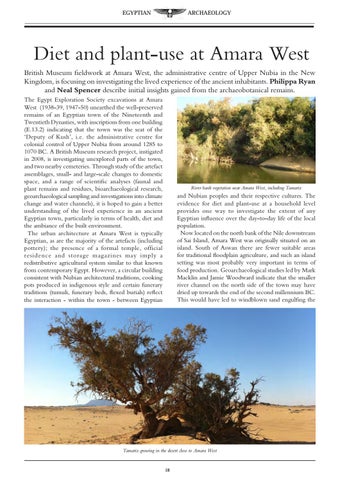
River bank vegetation near Amara West, including Tamarix
and Nubian peoples and their respective cultures. The evidence for diet and plant-use at a household level provides one way to investigate the extent of any Egyptian influence over the day-to-day life of the local population. Now located on the north bank of the Nile downstream of Sai Island, Amara West was originally situated on an island. South of Aswan there are fewer suitable areas for traditional floodplain agriculture, and such an island setting was most probably very important in terms of food production. Geoarchaeological studies led by Mark Macklin and Jamie Woodward indicate that the smaller river channel on the north side of the town may have dried up towards the end of the second millennium BC. This would have led to windblown sand engulfing the
Tamarix growing in the desert close to Amara West 18