EGYPTIAN
ARCHAEOLOGY
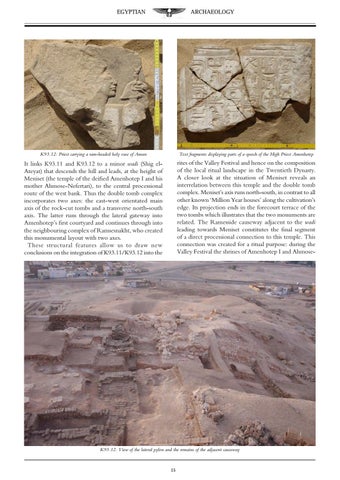
K93.12: Priest carrying a ram-headed holy vase of Amun
Text fragments displaying parts of a speech of the High Priest Amenhotep
It links K93.11 and K93.12 to a minor wadi (Shig elAteyat) that descends the hill and leads, at the height of Meniset (the temple of the deified Amenhotep I and his mother Ahmose-Nefertari), to the central processional route of the west bank. Thus the double tomb complex incorporates two axes: the east-west orientated main axis of the rock-cut tombs and a transverse north-south axis. The latter runs through the lateral gateway into Amenhotep’s first courtyard and continues through into the neighbouring complex of Ramsesnakht, who created this monumental layout with two axes. These structural features allow us to draw new conclusions on the integration of K93.11/K93.12 into the
rites of the Valley Festival and hence on the composition of the local ritual landscape in the Twentieth Dynasty. A closer look at the situation of Meniset reveals an interrelation between this temple and the double tomb complex. Meniset’s axis runs north-south, in contrast to all other known ‘Million Year houses’ along the cultivation’s edge. Its projection ends in the forecourt terrace of the two tombs which illustrates that the two monuments are related. The Ramesside causeway adjacent to the wadi leading towards Meniset constitutes the final segment of a direct processional connection to this temple. This connection was created for a ritual purpose: during the Valley Festival the shrines of Amenhotep I and Ahmose-
K93.12. View of the lateral pylon and the remains of the adjacent causeway
15