EGYPTIAN
ARCHAEOLOGY
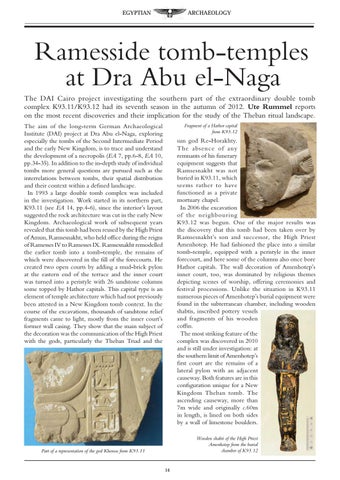
Ramesside tomb-temples at Dra Abu el-Naga The DAI Cairo project investigating the southern part of the extraordinary double tomb complex K93.11/K93.12 had its seventh season in the autumn of 2012. Ute Rummel reports on the most recent discoveries and their implication for the study of the Theban ritual landscape. The aim of the long-term German Archaeological Institute (DAI) project at Dra Abu el-Naga, exploring especially the tombs of the Second Intermediate Period and the early New Kingdom, is to trace and understand the development of a necropolis (EA 7, pp.6-8, EA 10, pp.34-35). In addition to the in-depth study of individual tombs more general questions are pursued such as the interrelations between tombs, their spatial distribution and their context within a defined landscape. In 1993 a large double tomb complex was included in the investigation. Work started in its northern part, K93.11 (see EA 14, pp.4-6), since the interior’s layout suggested the rock architecture was cut in the early New Kingdom. Archaeological work of subsequent years revealed that this tomb had been reused by the High Priest of Amun, Ramsesnakht, who held office during the reigns of Ramesses IV to Ramesses IX. Ramsesnakht remodelled the earlier tomb into a tomb-temple, the remains of which were discovered in the fill of the forecourts. He created two open courts by adding a mud-brick pylon at the eastern end of the terrace and the inner court was turned into a peristyle with 26 sandstone columns some topped by Hathor capitals. This capital type is an element of temple architecture which had not previously been attested in a New Kingdom tomb context. In the course of the excavations, thousands of sandstone relief fragments came to light, mostly from the inner court’s former wall casing. They show that the main subject of the decoration was the communication of the High Priest with the gods, particularly the Theban Triad and the
Fragment of a Hathor capital from K93.12
sun god Re-Horakhty. The absence of any remnants of his funerary equipment suggests that Ramsesnakht was not buried in K93.11, which seems rather to have functioned as a private mortuary chapel. In 2006 the excavation of the neighbouring K93.12 was begun. One of the major results was the discovery that this tomb had been taken over by Ramsesnakht’s son and successor, the High Priest Amenhotep. He had fashioned the place into a similar tomb-temple, equipped with a peristyle in the inner forecourt, and here some of the columns also once bore Hathor capitals. The wall decoration of Amenhotep’s inner court, too, was dominated by religious themes depicting scenes of worship, offering ceremonies and festival processions. Unlike the situation in K93.11 numerous pieces of Amenhotep’s burial equipment were found in the subterranean chamber, including wooden shabtis, inscribed pottery vessels and fragments of his wooden coffin. The most striking feature of the complex was discovered in 2010 and is still under investigation: at the southern limit of Amenhotep’s first court are the remains of a lateral pylon with an adjacent causeway. Both features are in this configuration unique for a New Kingdom Theban tomb. The ascending causeway, more than 7m wide and originally c.60m in length, is lined on both sides by a wall of limestone boulders. Wooden shabti of the High Priest Amenhotep from the burial chamber of K93.12
Part of a representation of the god Khonsu from K93.11 14