EGYPTIAN
ARCHAEOLOGY
Postcard from Naville to Amelia Edwards, 7th March 1887. [EES Lucy Gura Archive V.e.12]. © Egypt Exploration Society
Archive V.e.8]. Naville’s views were influenced by his wish to maintain good relations with the French Egyptologists who controlled the Service des Antiquités, as well as with officials of the Egyptian Museum, then at Bulaq. Since the departure of his friend Maspero in 1886 Naville had had a less friendly relationship with Eugène Grébaut, the new Director of the Service. Petrie features in this correspondence particularly around the end of the year 1886 when the English archaeologist decided to resign from the Fund. Originally, Naville regarded Petrie as a colleague, even a friend, and during their first excavations in the Delta he consulted him about small finds and ceramics, and paid visits to Petrie’s fieldwork to have a look at the epigraphic material. Both men were complementary, using different methods, a fact Naville always had in mind. He pointed out their differences in a letter to Poole: ‘I consider that the English public is much more interested in Petrie’s work than in mine. I do not feel the least jealous about it; I consider it as quite natural. He is an Englishman, I a foreigner. He makes exhibitions of what he finds; I make none. He is more archaeologist than I am. I believe he is a great loss to the Fund’ [25th November 1886, EES archive V.d.19].
Edouard and Marguerite Naville, in the garden of their estate at Malagny near Geneva. Photograph © Fondation Naville
Naville also believed that inscriptions provided the most important evidence to establish the historical context of a site, and, in this, his approach to archaeology clearly differed from Petrie’s, as the letters show: ‘I have here a little box containing little pots, scarabs, bronzes, and flint implements which I found at Khataaneh and Tell el Rotab. I am quite ashamed of sending you that; but Mr. Petrie said the pottery is interesting. I should give the whole for a bit of inscriptions’ [Letter to Poole, 4th April 1885, EES Lucy Gura Archive V.c.15]. Eventually, within this early correspondence eight letters in French are written by Marguerite Naville - born de Pourtalès - who married Edouard in 1873. She is known for the beautiful drawings she made for her husband’s Memoirs, although she is not always mentioned among his collaborators in their introductions. Thanks to the EES archive we know that she was also deeply involved in the numerous editing stages of each publication. She used to adapt the squeezes or facsimile drawings and re-draw them with a pantograph at home, took care of the last verifications and checked the proportions, labels, scales and the final layout of the plates. She was an efficient assistant to Edouard and both the Fund’s Secretaries always showed confidence in her thorough work. By this historiographical approach, Naville’s letters reveal new aspects of his excavations and his collaborators as he initiated archaeology in the Delta. In the case of large projects, as for instance at Bubastis, the correspondence reveals new information about the context of many excavated monuments and will enhance existing publications. It is also an opportunity to enlarge our knowledge about the distribution lists regarding the objects sent to museums in Europe, the United States and as far afield as Australia. q Hélène Virenque is a Research Associate at the Ecole pratique des hautes études, EA 4519 ‘Egypte ancienne, archéologie, langue, religion’ (Paris). For her research on Naville’s correspondence, she received in 2010 an EES Centenary Award and in 2011 the Prix Max Serres of the Académie des Inscriptions et Belles-Lettres (Paris). She would like to thank the EES, especially Chris Naunton and Patricia Spencer, as well as Jean-Luc Chappaz (MAH, Geneva) and the Naville family for their constant support.
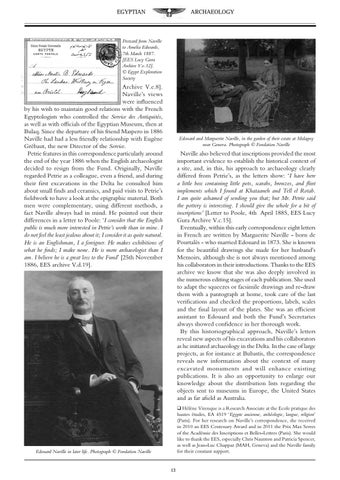
Edouard Naville in later life. Photograph © Fondation Naville 13