EGYPTIAN
ARCHAEOLOGY
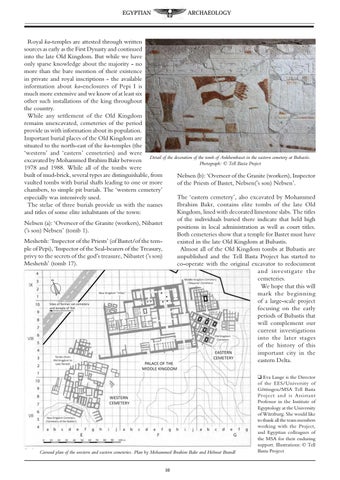
Royal ka-temples are attested through written sources as early as the First Dynasty and continued into the late Old Kingdom. But while we have only sparse knowledge about the majority - no more than the bare mention of their existence in private and royal inscriptions - the available information about ka-enclosures of Pepi I is much more extensive and we know of at least six other such installations of the king throughout the country. While any settlement of the Old Kingdom remains unexcavated, cemeteries of the period provide us with information about its population. Important burial places of the Old Kingdom are situated to the north-east of the ka-temples (the ‘western’ and ‘eastern’ cemeteries) and were Detail of the decoration of the tomb of Ankhembaset in the eastern cemetery at Bubastis. excavated by Mohammed Ibrahim Bakr between Photograph: © Tell Basta Project 1978 and 1988. While all of the tombs were built of mud-brick, several types are distinguishable, from Nebsen (b): ‘Overseer of the Granite (workers), Inspector vaulted tombs with burial shafts leading to one or more of the Priests of Bastet, Nebsen(’s son) Nebsen’. chambers, to simple pit burials. The ‘western cemetery’ The ‘eastern cemetery’, also excavated by Mohammed especially was intensively used. Ibrahim Bakr, contains elite tombs of the late Old The stelae of three burials provide us with the names Kingdom, lined with decorated limestone slabs. The titles and titles of some elite inhabitants of the town: of the individuals buried there indicate that held high Nebsen (a): ‘Overseer of the Granite (workers), Nibastet positions in local administration as well as court titles. (’s son) Nebsen’ (tomb 1). Both cemeteries show that a temple for Bastet must have Meshetsh: ‘Inspector of the Priests’ (of Bastet/of the temexisted in the late Old Kingdom at Bubastis. ple of Pepi), ‘Inspector of the Seal-bearers of the Treasury, Almost all of the Old Kingdom tombs at Bubastis are privy to the secrets of the god’s treasure, Nibastet (’s son) unpublished and the Tell Basta Project has started to Meshetsh’ (tomb 17). co-operate with the original excavator to redocument and investigate the cemeteries. We hope that this will mark the beginning of a large-scale project focusing on the early periods of Bubastis that will complement our current investigations into the later stages of the history of this important city in the eastern Delta.
Ground plan of the western and eastern cemeteries. Plan by Mohammed Ibrahim Bakr and Helmut Brandl 10
q Eva Lange is the Director of the EES/University of Göttingen/MSA Tell Basta Project and is Assistant Professor in the Institute of Egyptology at the University of Würzburg. She would like to thank all the team members working with the Project, and Egyptian colleagues of the MSA for their enduring support. Illustrations: © Tell Basta Project