EGYPTIAN
ARCHAEOLOGY
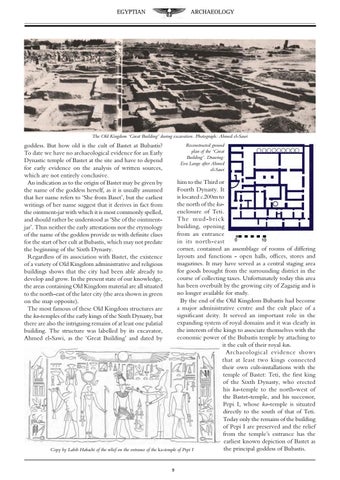
The Old Kingdom ‘Great Building’ during excavation. Photograph: Ahmed el-Sawi
goddess. But how old is the cult of Bastet at Bubastis? To date we have no archaeological evidence for an Early Dynastic temple of Bastet at the site and have to depend for early evidence on the analysis of written sources, which are not entirely conclusive. An indication as to the origin of Bastet may be given by the name of the goddess herself, as it is usually assumed that her name refers to ‘She from Baset’, but the earliest writings of her name suggest that it derives in fact from the ointment-jar with which it is most commonly spelled, and should rather be understood as ‘She of the ointmentjar’. Thus neither the early attestations nor the etymology of the name of the goddess provide us with definite clues for the start of her cult at Bubastis, which may not predate the beginning of the Sixth Dynasty. Regardless of its association with Bastet, the existence of a variety of Old Kingdom administrative and religious buildings shows that the city had been able already to develop and grow. In the present state of our knowledge, the areas containing Old Kingdom material are all situated to the north-east of the later city (the area shown in green on the map opposite). The most famous of these Old Kingdom structures are the ka-temples of the early kings of the Sixth Dynasty, but there are also the intriguing remains of at least one palatial building. The structure was labelled by its excavator, Ahmed el-Sawi, as the ‘Great Building’ and dated by
Reconstructed ground plan of the ‘Great Building’. Drawing: Eva Lange after Ahmed el-Sawi
him to the Third or Fourth Dynasty. It is located c.200m to the north of the kaenclosure of Teti. The mud-brick building, opening from an entrance in its north-east corner, contained an assemblage of rooms of differing layouts and functions - open halls, offices, stores and magazines. It may have served as a central staging area for goods brought from the surrounding district in the course of collecting taxes. Unfortunately today this area has been overbuilt by the growing city of Zagazig and is no longer available for study. By the end of the Old Kingdom Bubastis had become a major administrative centre and the cult place of a significant deity. It served an important role in the expanding system of royal domains and it was clearly in the interests of the kings to associate themselves with the economic power of the Bubastis temple by attaching to it the cult of their royal kas. Archaeological evidence shows that at least two kings connected their own cult-installations with the temple of Bastet: Teti, the first king of the Sixth Dynasty, who erected his ka-temple to the north-west of the Bastet-temple, and his successor, Pepi I, whose ka-temple is situated directly to the south of that of Teti. Today only the remains of the building of Pepi I are preserved and the relief from the temple’s entrance has the earliest known depiction of Bastet as the principal goddess of Bubastis. Copy by Labib Habachi of the relief on the entrance of the ka-temple of Pepi I