EGYPTIAN
ARCHAEOLOGY
The Old Kingdom temples
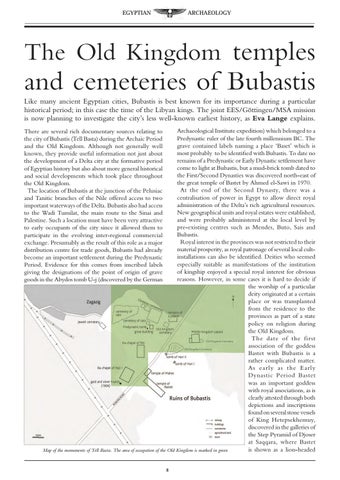
and cemeteries of Bubastis Like many ancient Egyptian cities, Bubastis is best known for its importance during a particular historical period; in this case the time of the Libyan kings. The joint EES/Göttingen/MSA mission is now planning to investigate the city’s less well-known earliest history, as Eva Lange explains. Archaeological Institute expedition) which belonged to a Predynastic ruler of the late fourth millennium BC. The grave contained labels naming a place ‘Baset’ which is most probably to be identified with Bubastis. To date no remains of a Predynastic or Early Dynastic settlement have come to light at Bubastis, but a mud-brick tomb dated to the First/Second Dynasties was discovered north-east of the great temple of Bastet by Ahmed el-Sawi in 1970. At the end of the Second Dynasty, there was a centralisation of power in Egypt to allow direct royal administration of the Delta’s rich agricultural resources. New geographical units and royal estates were established, and were probably administered at the local level by pre-existing centres such as Mendes, Buto, Sais and Bubastis. Royal interest in the provinces was not restricted to their material prosperity, as royal patronage of several local cultinstallations can also be identified. Deities who seemed especially suitable as manifestations of the institution of kingship enjoyed a special royal interest for obvious reasons. However, in some cases it is hard to decide if the worship of a particular deity originated at a certain place or was transplanted from the residence to the provinces as part of a state policy on religion during the Old Kingdom. The date of the first association of the goddess Bastet with Bubastis is a rather complicated matter. As early as the Early Dynastic Period Bastet was an important goddess with royal associations, as is clearly attested through both depictions and inscriptions found on several stone vessels of King Hetepsekhemuy, discovered in the galleries of the Step Pyramid of Djoser at Saqqara, where Bastet is shown as a lion-headed Map of the monuments of Tell Basta. The area of occupation of the Old Kingdom is marked in green
There are several rich documentary sources relating to the city of Bubastis (Tell Basta) during the Archaic Period and the Old Kingdom. Although not generally well known, they provide useful information not just about the development of a Delta city at the formative period of Egyptian history but also about more general historical and social developments which took place throughout the Old Kingdom. The location of Bubastis at the junction of the Pelusiac and Tanitic branches of the Nile offered access to two important waterways of the Delta. Bubastis also had access to the Wadi Tumilat, the main route to the Sinai and Palestine. Such a location must have been very attractive to early occupants of the city since it allowed them to participate in the evolving inter-regional commercial exchange. Presumably as the result of this role as a major distribution centre for trade goods, Bubastis had already become an important settlement during the Predynastic Period. Evidence for this comes from inscribed labels giving the designations of the point of origin of grave goods in the Abydos tomb U-j (discovered by the German