EGYPTIAN
ARCHAEOLOGY
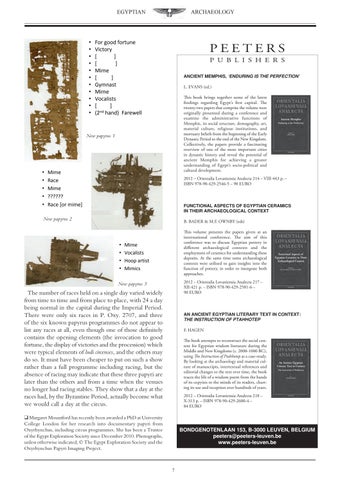
• For good fortune • Victory • [ ] • [ ] • Mime • [ ] • Gymnast • Mime • Vocalists • [ ] • (2nd hand) Farewell
PEETERS P U B L I S H E R S Ancient MeMphis, ‘Enduring is thE PErfEction’ L. EvanS (ed.) This book brings together some of the latest findings regarding Egypt’s first capital. The twenty-two papers that comprise the volume were originally presented during a conference and examine the administrative functions of Memphis, its social structure, demography, art, material culture, religious institutions, and mortuary beliefs from the beginning of the Early Dynastic Period to the end of the New Kingdom. Collectively, the papers provide a fascinating overview of one of the most important cities in dynastic history and reveal the potential of ancient Memphis for achieving a greater understanding of Egypt’s socio-political and cultural development.
New papyrus 1
• Mime • Race • Mime • ?????? • Race [or mime]
2012 – Orientalia Lovaniensia Analecta 214 – VIII-443 p. – ISBN 978-90-429-2546-5 – 90 EURO
FunctionAl Aspects oF egyptiAn cerAMics in their ArchAeologicAl context
New papyrus 2
B. BADER & M.F. OwNBy (eds) This volume presents the papers given at an international conference. The aim of this conference was to discuss Egyptian pottery in different archaeological contexts and the employment of ceramics for understanding these deposits. At the same time some archaeological contexts were utilised to gain insights into the function of pottery, in order to intergrate both approaches.
• Mime • Vocalists • Hoop artist • Mimics
2012 – Orientalia Lovaniensia Analecta 217 – XII-421 p. – ISBN 978-90-429-2581-6 – 90 EURO
New papyrus 3
The number of races held on a single day varied widely from time to time and from place to place, with 24 a day being normal in the capital during the Imperial Period. There were only six races in P. Oxy. 2707, and three of the six known papyrus programmes do not appear to list any races at all, even though one of those definitely contains the opening elements (the invocation to good fortune, the display of victories and the procession) which were typical elements of ludi circenses, and the others may do so. It must have been cheaper to put on such a show rather than a full programme including racing, but the absence of racing may indicate that these three papyri are later than the others and from a time when the venues no longer had racing stables. They show that a day at the races had, by the Byzantine Period, actually become what we would call a day at the circus.
An Ancient egyptiAn literAry text in context: thE instruction of PtahhotEP F. HAgEN The book attempts to reconstruct the social context for Egyptian wisdom literature during the Middle and New Kingdoms (c. 2000-1000 BC), using The Instruction of Ptahhotep as a case-study. By looking at the archaeology and material culture of manuscripts, intertextual references and editorial changes to the text over time, the book traces the life of a wisdom poem from the hands of its copyists to the minds of its readers, charting its use and reception over hundreds of years. 2012 – Orientalia Lovaniensia Analecta 218 – X-313 p. – ISBN 978-90-429-2600-4 – 84 EURO
q Margaret Mountford has recently been awarded a PhD at University College London for her research into documentary papyri from Oxyrhynchus, including circus programmes. She has been a Trustee of the Egypt Exploration Society since December 2010. Photographs, unless otherwise indicated, © The Egypt Exploration Society and the Oxyrhynchus Papyri Imaging Project.
BonDgenotenlAAn 153, B-3000 leuVen, BelgiuM peeters@peeters-leuven.be www.peeters-leuven.be
95262_EgArch_advertentie_3.indd 1