EGYPTIAN
ARCHAEOLOGY
One wonders whether, in a town like Oxyrhynchus, there would have been sufficient variety of entertainers to keep the people amused; perhaps the horses and riders remained in the same stables or racing yards but the other artists continued to travel around from one games to another, as they had centuries before. Three circus programmes have been published so far; the only complete one is also from Oxyrhynchus (P. Oxy. XXXIV 2707). It lists six races, with items such as singing stilt-walkers, athletes and mimes (the most common and so, presumably, the most popular or the least expensive entertainment) in between. Other known types of entertainers included mimics, gymnasts, tightand slack-rope walkers and performers with hoops. All the programmes which are preserved intact start with an invocation to good fortune (a throw-back to pagan times when Tyche, the goddess of the fortune of the city, was invoked) and some form of display of victory or victories, probably statues or panels symbolising the Emperor. A procession of all the performers also regularly took place, possibly including imperial representatives and local dignitaries. The entertainments were provided free for the crowds, but it is not entirely clear how they were funded by the time of these papyri; possibly there was no single source of finance. The emperor paid for entertainments in Constantinople and it would seem logical, if the same political purpose was to be achieved, that the imperial role
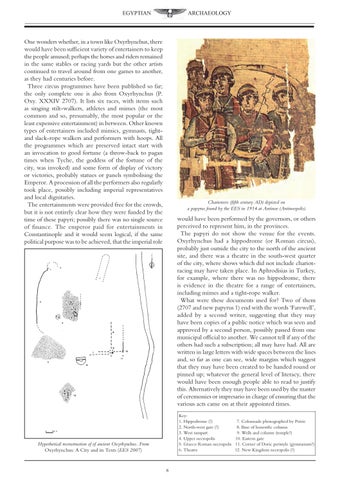
Charioteers (fifth century AD) depicted on a papyrus found by the EES in 1914 at Antinoe (Antinoopolis)
would have been performed by the governors, or others perceived to represent him, in the provinces. The papyri do not show the venue for the events. Oxyrhynchus had a hippodrome (or Roman circus), probably just outside the city to the north of the ancient site, and there was a theatre in the south-west quarter of the city, where shows which did not include chariotracing may have taken place. In Aphrodisias in Turkey, for example, where there was no hippodrome, there is evidence in the theatre for a range of entertainers, including mimes and a tight-rope walker. What were these documents used for? Two of them (2707 and new papyrus 1) end with the words ‘Farewell’, added by a second writer, suggesting that they may have been copies of a public notice which was seen and approved by a second person, possibly passed from one municipal official to another. We cannot tell if any of the others had such a subscription; all may have had. All are written in large letters with wide spaces between the lines and, so far as one can see, wide margins which suggest that they may have been created to be handed round or pinned up; whatever the general level of literacy, there would have been enough people able to read to justify this. Alternatively they may have been used by the master of ceremonies or impresario in charge of ensuring that the various acts came on at their appointed times. Key: 1. Hippodrome (?) 7. Colonnade photographed by Petrie 2. North-west gate (?) 8. Base of honorific column 3. West rampart 9. Wells and column (temple?) 4. Upper necropolis 10. Eastern gate 5. Graeco Roman necropolis 11. Corner of Doric peristyle (gymnasium?) 6. Theatre 12. New Kingdom necropolis (?)
Hypothetical reconstruction of of ancient Oxyrhynchus. From Oxyrhynchus: A City and its Texts (EES 2007)