EGYPTIAN
entrepreneur. Whenever a new discovery or fresh opportunity arose, he promptly exploited it to appeal for additional funding, usually with success. At any given time Breasted might have a dozen or more endeavours under way, such as the Coffin Texts project (‘the most formidable task I have ever undertaken’), begun with Alan H Gardiner and eventually handed on to Adriaan de Buck. He could also be helpful to others by finding financial support for their work. But eventually he came to be envied, and to a considerable degree resented, for what some of his contemporaries considered a monopolisation of resources that became ever scarcer with the onset of the Great Depression. His defiant response to such adversity was invariably to advance increasingly grandiose proposals. It was perhaps a mercy that Breasted died before receiving the letter from his major patron, John D Rockefeller, Jr, that informed him in no uncertain terms that he had to curtail the scope of his enterprises. But while some of Breasted’s initiatives were unrealistic, many more were enduring. On the institutional level, his crowning achievement was the creation in 1919 of the Oriental Institute at the University of Chicago, one of the premier centres for the study of not only ancient Egypt but also the entire ancient Near East. In 1924 he established the Epigraphic Survey of the University of Chicago, popularly known as Chicago House, in pursuit of his longstanding ambition ‘to copy all the inscriptions of Egypt and publish them’. That was a bit too ambitious, to say the least, but the Epigraphic Survey continues to this day, recording increasingly endangered messages from the distant past. Breasted would present a daunting challenge to any biographer, but Jeffrey Abt brings a number of pertinent skills into play with good results. Drawing on his established track record as an institutional historian, Abt is able to make sense of Breasted’s incomparable and almost incredibly complex academic entrepreneurship. One example is the analysis of Breasted’s ‘Unbuilt Museum’ in Cairo. With a generous commitment of support from Rockefeller, Breasted intended it to be ‘the finest modern monument in Egypt’ and ‘a temple of the unfolding life of man’. In the event, however, the project proved unacceptable to the Egyptian government. Until fairly recently the conventional wisdom, as expressed by Breasted’s student John A Wilson, was that ‘a brilliant opportunity was sacrificed to bickering and petty politics’. Abt has now demonstrated that ‘the great Egyptian museum Breasted proposed could not be realized without the Egyptians ceding control over their antiquities’, that ‘to the Egyptian leadership, the project raised the specter of a highly visible capitulation of Egyptian sovereignty, a political liability they could ill afford in a time of nationalist turmoil’. Abt’s expertise as an artist and art historian is also effectively applied. Again to provide just one example, his explanation of the ‘Chicago House method’ of epigraphic copying, a complex subject that does not readily lend itself to description, is a model of clarity. The personal touches about Breasted are
ARCHAEOLOGY
present, tastefully told and in just the right depth to delineate a real human being and to suggest how his personal life conditioned his professional life. One learns that his first and longest marriage was often a trial, depriving him of the solace and additional creative space he might have sought at home, away from his ambitious agenda at work. That was because Frances Hart Breasted never fully recovered her emotional equilibrium after a drunken obstetrician fatally bungled the delivery of their first child. Also, while Breasted was certainly a loyal friend, inspiring teacher, and able administrator, it becomes clear that he was not always the easiest person to work with. Breasted’s stature was such that there has been a tendency to assume that any person or organisation that differed from him was necessarily in the wrong. Stripping away some of the gilding allows an even brighter personality and more authentic character to shine through. The history of Egyptology is an active, rapidly growing field. American Egyptologist is a major contribution to it. JASON THOMPSON
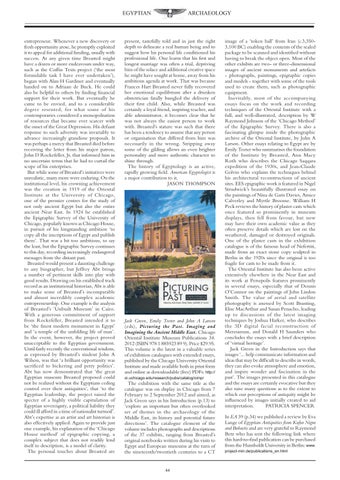
Jack Green, Emily Teeter and John A Larson (eds), Picturing the Past. Imaging and Imagining the Ancient Middle East. Chicago Oriental Institute Museum Publications 34. 2012 (ISBN 978 1 885923 89 9). Price $29.95. This volume is the latest in a valuable series of exhibition catalogues with extended essays, published by the Chicago University Oriental Institute and made available both in print form and online as downloadable (free) PDFs: http:// oi.uchicago.edu/research/pubs/catalog/oimp/
The exhibition with the same title as the catalogue was on display in Chicago from 7 February to 2 September 2012 and aimed, as Jack Green says in his Introduction (p.13) to ‘explore an important but often overlooked set of themes in the archaeology of the Middle East, its history and potential future directions’. The catalogue element of the volume includes photographs and descriptions of the 37 exhibits, ranging from Breasted’s original notebooks written during his visits to Egypt and European museums at the turn of the nineteenth/twentieth centuries to a CT 44
image of a ‘token ball’ from Iran (c.3,3503,100 BC) enabling the contents of the sealed package to be scanned and identified without having to break the object open. Most of the other exhibits are two- or three-dimensional images of ancient monuments and artefacts - photographs, paintings, epigraphic copies and models - together with some of the tools used to create them, such as photographic equipment. Inevitably, most of the accompanying essays focus on the work and recording techniques of the Oriental Institute with a full, and well-illustrated, description by W Raymond Johnson of the ‘Chicago Method’ of the Epigraphic Survey. There is also a fascinating glimpse inside the photographic archive of the Oriental Institute, by John A Larson. Other essays relating to Egypt are by Emily Teeter who summarises the foundation of the Institute by Breasted, Ann Macy Roth who describes the Chicago Saqqara expedition of the 1930s, and Jean-Claude Golvin who explains the techniques behind his architectural reconstructions of ancient sites. EES epigraphic work is featured in Nigel Strudwick’s beautifully illustrated essay on the paintings of Nina de Garis Davies, Amice Calverley and Myrtle Broome. William H Peck reviews the history of plaster casts which once featured so prominently in museum displays, then fell from favour, but now may have their own academic value as they often preserve details which are lost on the weathered, damaged or destroyed originals. One of the plaster casts in the exhibition catalogue is of the famous head of Nefertiti, made from an exact stone copy sculpted in Berlin in the 1920s since the original is too fragile for casts to be made from it. The Oriental Institute has also been active extensively elsewhere in the Near East and its work at Persepolis features prominently in several essays, especially that of Dennis O’Connor on the paintings of John Lindon Smith. The value of aerial and satellite photography is assessed by Scott Branting, Elise MacArthur and Susan Penacho, leading up to discussions of the latest imaging techniques by Joshua Harker, who describes the 3D digital facial reconstruction of Meresamun, and Donald H Saunders who concludes the essays with a brief description of ‘virtual heritage’. Jack Green in the Introduction says that images ‘... help communicate information and ideas that may be difficult to describe in words, they can also evoke atmosphere and emotion, and inspire wonder and fascination in the past’. The images presented in this catalogue and the essays are certainly evocative but they also raise many questions as to the extent to which our perceptions of antiquity might be influenced by images initially created to aid interpretation. PATRICIA SPENCER In EA 39 (p.34) we published a review by Eva Lange of Egyptian Antiquities from Kufur Nigm and Bubastis and are very grateful to Raymond Betz who has sent the following link where this hard-to-find publication can be purchased from the Humboldt University in Berlin: www. project-min.de/publications_en.html