EGYPTIAN
ARCHAEOLOGY
The Valley of the Kings: two burials in KV 64 The University of Basel Kings’ Valley Project is exploring the non-royal tombs in the side valley leading to the cliff tomb of Tuthmosis III. A new shaft tomb with two consecutive burials was investigated early this year. Susanne Bickel and Elina Paulin-Grothe report on the find.
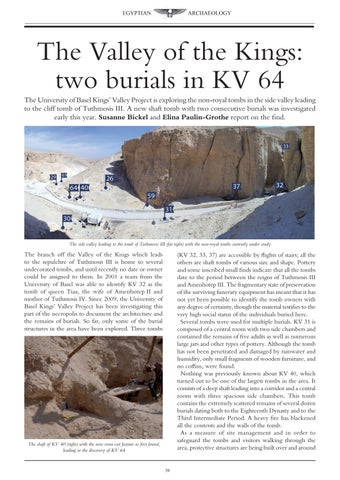
The side valley leading to the tomb of Tuthmosis III (far right) with the non-royal tombs currently under study
The branch off the Valley of the Kings which leads to the sepulchre of Tuthmosis III is home to several undecorated tombs, and until recently no date or owner could be assigned to them. In 2001 a team from the University of Basel was able to identify KV 32 as the tomb of queen Tiaa, the wife of Amenhotep II and mother of Tuthmosis IV. Since 2009, the University of Basel Kings’ Valley Project has been investigating this part of the necropolis to document the architecture and the remains of burials. So far, only some of the burial structures in the area have been explored. Three tombs
(KV 32, 33, 37) are accessible by flights of stairs; all the others are shaft tombs of various size and shape. Pottery and some inscribed small finds indicate that all the tombs date to the period between the reigns of Tuthmosis III and Amenhotep III. The fragmentary state of preservation of the surviving funerary equipment has meant that it has not yet been possible to identify the tomb owners with any degree of certainty, though the material testifies to the very high social status of the individuals buried here. Several tombs were used for multiple burials. KV 31 is composed of a central room with two side chambers and contained the remains of five adults as well as numerous large jars and other types of pottery. Although the tomb has not been penetrated and damaged by rainwater and humidity, only small fragments of wooden furniture, and no coffins, were found. Nothing was previously known about KV 40, which turned out to be one of the largest tombs in the area. It consists of a deep shaft leading into a corridor and a central room with three spacious side chambers. This tomb contains the extremely scattered remains of several dozen burials dating both to the Eighteenth Dynasty and to the Third Intermediate Period. A heavy fire has blackened all the contents and the walls of the tomb. As a measure of site management and in order to safeguard the tombs and visitors walking through the area, protective structures are being built over and around
The shaft of KV 40 (right) with the new stone-cut feature as first found, leading to the discovery of KV 64
36