EGYPTIAN
ARCHAEOLOGY
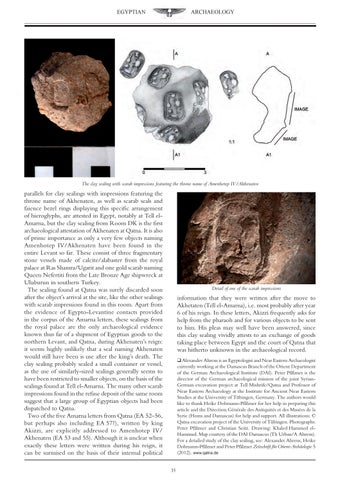
The clay sealing with scarab impressions featuring the throne name of Amenhotep IV/Akhenaten
parallels for clay sealings with impressions featuring the throne name of Akhenaten, as well as scarab seals and faience bezel rings displaying this specific arrangement of hieroglyphs, are attested in Egypt, notably at Tell elAmarna, but the clay sealing from Room DK is the first archaeological attestation of Akhenaten at Qatna. It is also of prime importance as only a very few objects naming Amenhotep IV/Akhenaten have been found in the entire Levant so far. These consist of three fragmentary stone vessels made of calcite/alabaster from the royal palace at Ras Shamra/Ugarit and one gold scarab naming Queen Nefertiti from the Late Bronze Age shipwreck at Uluburun in southern Turkey. The sealing found at Qatna was surely discarded soon after the object’s arrival at the site, like the other sealings with scarab impressions found in this room. Apart from the evidence of Egypto-Levantine contacts provided in the corpus of the Amarna letters, these sealings from the royal palace are the only archaeological evidence known thus far of a shipment of Egyptian goods to the northern Levant, and Qatna, during Akhenaten’s reign: it seems highly unlikely that a seal naming Akhenaten would still have been is use after the king’s death. The clay sealing probably sealed a small container or vessel, as the use of similarly-sized sealings generally seems to have been restricted to smaller objects, on the basis of the sealings found at Tell el-Amarna. The many other scarab impressions found in the refuse deposit of the same room suggest that a large group of Egyptian objects had been dispatched to Qatna. Two of the five Amarna letters from Qatna (EA 52–56, but perhaps also including EA 57?), written by king Akizzi, are explicitly addressed to Amenhotep IV/ Akhenaten (EA 53 and 55). Although it is unclear when exactly these letters were written during his reign, it can be surmised on the basis of their internal political
Detail of one of the scarab impressions
information that they were written after the move to Akhetaten (Tell el-Amarna), i.e. most probably after year 6 of his reign. In these letters, Akizzi frequently asks for help from the pharaoh and for various objects to be sent to him. His pleas may well have been answered, since this clay sealing vividly attests to an exchange of goods taking place between Egypt and the court of Qatna that was hitherto unknown in the archaeological record. q Alexander Ahrens is an Egyptologist and Near Eastern Archaeologist currently working at the Damascus Branch of the Orient Department of the German Archaeological Institute (DAI). Peter Pfälzner is the director of the German archaeological mission of the joint SyrianGerman excavation project at Tell Mishrife/Qatna and Professor of Near Eastern Archaeology at the Institute for Ancient Near Eastern Studies at the University of Tübingen, Germany. The authors would like to thank Heike Dohmann-Pfälzner for her help in preparing this article and the Direction Générale des Antiquités et des Musées de la Syrie (Homs and Damascus) for help and support. All illustrations: © Qatna excavation project of the University of Tübingen. Photographs: Peter Pfälzner and Christian Seitz. Drawing: Khaled Hammed elHammud. Map courtesy of the DAI Damascus (Th Urban/A Ahrens). For a detailed study of the clay sealing, see: Alexander Ahrens, Heike Dohmann-Pfälzner and Peter Pfälzner Zeitschrift für Orient-Archäologie 5 (2012). www.qatna.de 35