EGYPTIAN
ARCHAEOLOGY
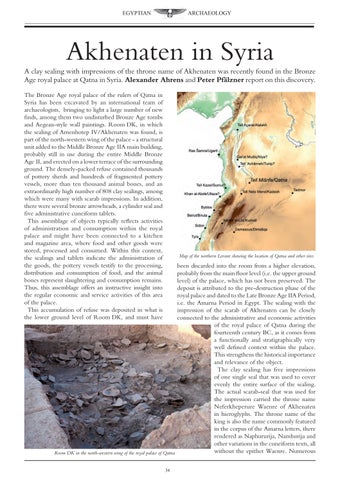
Akhenaten in Syria A clay sealing with impressions of the throne name of Akhenaten was recently found in the Bronze Age royal palace at Qatna in Syria. Alexander Ahrens and Peter Pfälzner report on this discovery. The Bronze Age royal palace of the rulers of Qatna in Syria has been excavated by an international team of archaeologists, bringing to light a large number of new finds, among them two undisturbed Bronze Age tombs and Aegean-style wall paintings. Room DK, in which the sealing of Amenhotep IV/Akhenaten was found, is part of the north-western wing of the palace - a structural unit added to the Middle Bronze Age IIA main building, probably still in use during the entire Middle Bronze Age II, and erected on a lower terrace of the surrounding ground. The densely-packed refuse contained thousands of pottery sherds and hundreds of fragmented pottery vessels, more than ten thousand animal bones, and an extraordinarily high number of 808 clay sealings, among which were many with scarab impressions. In addition, there were several bronze arrowheads, a cylinder seal and five administrative cuneiform tablets. This assemblage of objects typically reflects activities of administration and consumption within the royal palace and might have been connected to a kitchen and magazine area, where food and other goods were stored, processed and consumed. Within this context, the sealings and tablets indicate the administration of the goods, the pottery vessels testify to the processing, distribution and consumption of food, and the animal bones represent slaughtering and consumption remains. Thus, this assemblage offers an instructive insight into the regular economic and service activities of this area of the palace. This accumulation of refuse was deposited in what is the lower ground level of Room DK, and must have
Map of the northern Levant showing the location of Qatna and other sites
been discarded into the room from a higher elevation, probably from the main floor level (i.e. the upper ground level) of the palace, which has not been preserved. The deposit is attributed to the pre-destruction phase of the royal palace and dated to the Late Bronze Age IIA Period, i.e. the Amarna Period in Egypt. The sealing with the impression of the scarab of Akhenaten can be closely connected to the administrative and economic activities of the royal palace of Qatna during the fourteenth century BC, as it comes from a functionally and stratigraphically very well defined context within the palace. This strengthens the historical importance and relevance of the object. The clay sealing has five impressions of one single seal that was used to cover evenly the entire surface of the sealing. The actual scarab-seal that was used for the impression carried the throne name Neferkheperure Waenre of Akhenaten in hieroglyphs. The throne name of the king is also the name commonly featured in the corpus of the Amarna letters, there rendered as Naphururija, Namhurija and other variations in the cuneiform texts, all without the epithet Waenre. Numerous Room DK in the north-western wing of the royal palace of Qatna 34