EGYPTIAN
ARCHAEOLOGY
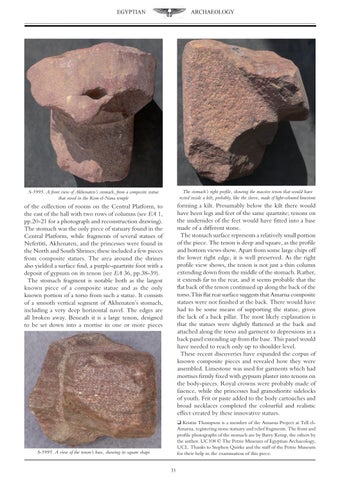
S-5995. A front view of Akhenaten’s stomach, from a composite statue that stood in the Kom el-Nana temple
The stomach’s right profile, showing the massive tenon that would have rested inside a kilt, probably, like the sleeve, made of light-coloured limestone
of the collection of rooms on the Central Platform, to the east of the hall with two rows of columns (see EA 1, pp.20-21 for a photograph and reconstruction drawing). The stomach was the only piece of statuary found in the Central Platform, while fragments of several statues of Nefertiti, Akhenaten, and the princesses were found in the North and South Shrines; these included a few pieces from composite statues. The area around the shrines also yielded a surface find, a purple-quartzite foot with a deposit of gypsum on its tenon (see EA 36, pp.38-39). The stomach fragment is notable both as the largest known piece of a composite statue and as the only known portion of a torso from such a statue. It consists of a smooth vertical segment of Akhenaten’s stomach, including a very deep horizontal navel. The edges are all broken away. Beneath it is a large tenon, designed to be set down into a mortise in one or more pieces
forming a kilt. Presumably below the kilt there would have been legs and feet of the same quartzite; tenons on the undersides of the feet would have fitted into a base made of a different stone. The stomach surface represents a relatively small portion of the piece. The tenon is deep and square, as the profile and bottom views show. Apart from some large chips off the lower right edge, it is well preserved. As the right profile view shows, the tenon is not just a thin column extending down from the middle of the stomach. Rather, it extends far to the rear, and it seems probable that the flat back of the tenon continued up along the back of the torso.This flat rear surface suggests that Amarna composite statues were not finished at the back. There would have had to be some means of supporting the statue, given the lack of a back pillar. The most likely explanation is that the statues were slightly flattened at the back and attached along the torso and garment to depressions in a back panel extending up from the base. This panel would have needed to reach only up to shoulder level. These recent discoveries have expanded the corpus of known composite pieces and revealed how they were assembled. Limestone was used for garments which had mortises firmly fixed with gypsum plaster into tenons on the body-pieces. Royal crowns were probably made of faience, while the princesses had granodiorite sidelocks of youth. Frit or paste added to the body cartouches and broad necklaces completed the colourful and realistic effect created by these innovative statues. q Kristin Thompson is a member of the Amarna Project at Tell elAmarna, registering stone statuary and relief fragments. The front and profile photographs of the stomach are by Barry Kemp, the others by the author. UC108 © The Petrie Museum of Egyptian Archaeology, UCL. Thanks to Stephen Quirke and the staff of the Petrie Museum for their help in the examination of this piece.
S-5995. A view of the tenon’s base, showing its square shape 33