EGYPTIAN
ARCHAEOLOGY
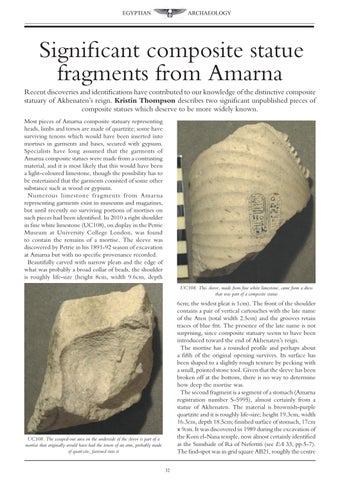
Significant composite statue fragments from Amarna Recent discoveries and identifications have contributed to our knowledge of the distinctive composite statuary of Akhenaten’s reign. Kristin Thompson describes two significant unpublished pieces of composite statues which deserve to be more widely known. Most pieces of Amarna composite statuary representing heads, limbs and torsos are made of quartzite; some have surviving tenons which would have been inserted into mortises in garments and bases, secured with gypsum. Specialists have long assumed that the garments of Amarna composite statues were made from a contrasting material, and it is most likely that this would have been a light-coloured limestone, though the possibility has to be entertained that the garments consisted of some other substance such as wood or gypsum. Numerous limestone fragments from Amarna representing garments exist in museums and magazines, but until recently no surviving portions of mortises on such pieces had been identified. In 2010 a right shoulder in fine white limestone (UC108), on display in the Petrie Museum at University College London, was found to contain the remains of a mortise. The sleeve was discovered by Petrie in his 1891-92 season of excavation at Amarna but with no specific provenance recorded. Beautifully carved with narrow pleats and the edge of what was probably a broad collar of beads, the shoulder is roughly life-size (height 8cm, width 9.6cm, depth UC108. This sleeve, made from fine white limestone, came from a dress that was part of a composite statue
6cm; the widest pleat is 1cm). The front of the shoulder contains a pair of vertical cartouches with the late name of the Aten (total width 2.5cm) and the grooves retain traces of blue frit. The presence of the late name is not surprising, since composite statuary seems to have been introduced toward the end of Akhenaten’s reign. The mortise has a rounded profile and perhaps about a fifth of the original opening survives. Its surface has been shaped to a slightly rough texture by pecking with a small, pointed stone tool. Given that the sleeve has been broken off at the bottom, there is no way to determine how deep the mortise was. The second fragment is a segment of a stomach (Amarna registration number S-5995), almost certainly from a statue of Akhenaten. The material is brownish-purple quartzite and it is roughly life-size; height 19.3cm, width 16.3cm, depth 18.5cm; finished surface of stomach, 17cm x 9cm. It was discovered in 1989 during the excavation of the Kom el-Nana temple, now almost certainly identified as the Sunshade of Ra of Nefertiti (see EA 33, pp.5-7). The find-spot was in grid square AB21, roughly the centre
UC108. The scooped-out area on the underside of the sleeve is part of a mortise that originally would have had the tenon of an arm, probably made of quartzite, fastened into it 32