EGYPTIAN
show five small tells, which have since vanished. In addition, on an aerial photograph from 1955 outlines of a large angular structure are visible. Magnetometric investigations were conducted to gain more information on this structure and it was possible to verify parts of the N edge and the NW corner of the structure in the ground. In order to understand better the structure’s date and function, a small scale archaeological investigation is planned for the next season. http://www.dainst.org/ en/node/24238?ft=all
Buto: 1. The DAI team, directed by Ulrich Hartung, continued work N of the village of Sekhmawy and excavated further structures of the very beginning of the 1st Dyn. Several rooms of similar size (c.2m x 6m) are arranged side by side and accessible from corridors. So far, there are no round silos and fire places which are typical features of the subsequent occupation phase (early 1st Dyn). A rather large percentage of marl clay vessels (mainly cylindrical and wine jars) contrast with the almost exclusively locally produced pottery assemblage of the later occupation phases. 2. Supported by the French Ministry of Foreign Affairs, the Univ of Poitiers team, led by Pascale Ballet, continued excavation of the Ptolemaic/ Roman bath house in the NE part of Buto, constructed as a Greek-type tholos-bath and later changed into a Roman-type bath house with hypocaust system (see EA 40 p.16). The general survey of the site was continued with detailed surface sampling to investigate the development and interconnections of urban and industrial quarters from the early Ptolemaic Period until the late Byzantine Period. Tell Farkha (Gazala): The mission of the Jagiellonian Univ, Kraków, the Poznan Archaeological Museum and the PCMA, directed by Marek Chłodnicki and Krzysztof M. Ciałowicz, carried out fieldwork on the W Kom within the trench opened in 2006-09. Excavation of layers between the oldest phases of the administrativecultic centre (Naqada IIIB) and the top layers of the burned Naqadan residence revealed only a few, very badly preserved, remains of small rectangular rooms. Sherds included a few fragments of imported Palestinian pottery. On the central Kom a Naqada IIIB building with mud-brick walls, 1.5m-1.7m thick, was found, below the EDP settlement excavated in 2011. A new trench to verify geophysical survey results was opened on the NW slope of the kom and a round building, destroyed at the beginning of the 3rd Dyn, was found. Its interior diameter is 7m and its wall is 2m thick. On the E Kom work concentrated on the cemetery and settlement layers around mastaba grave no.10. To the N of it is a group of rooms bordered on the N by a 2m thick wall. A similar wall was found S of the mastaba. The test trench opened in 2011 on the E border of the kom was enlarged to reveal part of a huge room with two entrances built on the gezira sand. www.farkha.org Tell el-Murra: The Polish Archeological Expedition to the North-Eastern Nile Delta,
ARCHAEOLOGY
(Jagiellonian Univ, Kraków) led by Mariusz Jucha conducted work mostly in the SW of the site. Trench S3, where two graves of the second half of the 1st Dyn had been found, was enlarged and five more graves, often cut into each other, were explored, ranging in date from the early 1st Dyn to the end of the EDP. The graves mainly contain pottery vessels – among them shouldered jars with half-bows around the shoulder and cylindrical jars with decoration beneath the rim, as well as plain examples, beer jars and bowls. There are also several stone vessels – cylindrical jars, squat jars and bowls. The walls of several other mud-brick structures were also uncovered, with associated Naqada III material. www.murra.pl Tell el-Daba (Avaris): The work of the Austrian Archaeological Inst, Cairo, directed by Irene Forstner-Müller, continued in area R/III, the administrative centre of the 15th Dyn town. In the excavated area the structures are separated by two large main streets. Within the structures different uses of space are discernable, and the W part appears to have had a more official aspect than the E part, which appears more domestic in nature. The individual buildings are relatively well-preserved, up to a height of 1m, and in one case a staircase of mud-brick was discovered leading down from the street into one of the buildings. The plan of this area shows a systematic organisation during the SIP - the streets were used for the whole period the area was settled. Besides pottery, the major finds were sealing impressions (Egyptian, Levantine and Syrian), including another with the name of King Khyan and one of the 16th Dyn. An unusual find was a faience vessel in the shape of a hippopotamus. The season also included studies of Ptolemaic remains, the Minoan frescoes, human and animal bones, and plant remains. Heliopolis (Matariya): A joint project of the SCA and the University of Leipzig, directed by Aimen Ashmawy and Dietrich Raue, continued excavation of a sanctuary in the area called Suq elKhamis within the temple enclosure. Additional evidence for the reuse of Amarna Period blocks was gathered as well as new fragments of statues of Senwosret I that were re-erected in the W part of the temenos of this temple of Ramesses II.
Upper Egypt Qarara: After two years’ interruption, the Univ of Tübingen team, led by Béatrice Huber, investigated an area in the S of the Coptic site, far away from the main settlement. Some walls were revealed by excavation but it was not possible to define their exact function. No domestic installation has been discovered. The settlement had been abandoned and the constructions later collapsed. The area was then used as a cemetery by the Coptic population, so that the tombs lie here over the settlement and not beneath it, as is the case in other parts of the site. Archaeological material and textiles date the cemetery from the mid fourth to the fifth centuries. Both the settlement and cemetery were seriously looted in 2011 and the team had to clear and record a 20m by 20m area in the N part of the settlement after it had been dug down to the bedrock by sebbakhin. The stratigraphy and the inner structures of the houses, built directly over the Coptic cemetery, are inevitably disturbed but several periods of occupation can be observed. http://tinyurl.com/7vgdcuh Sharuna (Kom el-Ahmar): The Univ of Tübingen team, led by Béatrice Huber, continued the work begun in 2010 in the NW side of the rock necropolis (directed by Luis Gonzálves), completing research in the OK tomb M8b, where the inner chamber was excavated. Around M8b three completely robbed OK tombs Heliopolis: The excavation of the temple sanctuary in Suq elwith shafts and funerary chambers were Khamis. Photograph courtesy of Dietrich Raue 31
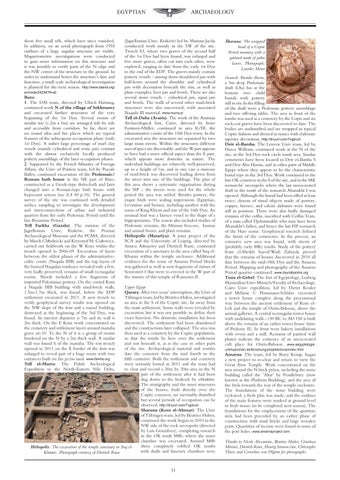
Sharuna: The wrapped head of a Coptic Period mummy with a garland made of palm leaves. Photograph: Lourdes Moret cleared. Beside them, a 5m deep Ptolemaic shaft (L8a) has at the bottom two child burials with pottery still in situ. In the filling of the shaft were a Ptolemaic pottery assemblage and two offering tables. The area in front of the tombs was used as a cemetery by the Copts and six rock-cut graves have been discovered to date. The bodies are undisturbed and are wrapped in typical Coptic fashion and dressed in tunics with elaborate tapestry decoration. http://tinyurl.com/7vgdcuh Deir el-Barsha: The Leuven Univ team, led by Harco Willems, continued work at the N of the site, in the 3rd Dyn rock circle tomb area. Similar cemeteries have been located in Deir el-Barsha S and Deir Abu Hinnis, and in other parts of Middle Egypt where they appear to be the characteristic burial type in the 3rd Dyn. Work continued in the late OK cemetery in the S of the site, and in the MK nomarchs’ necropolis where the last unexcavated shaft in the tomb of the nomarch Ahanakht I was opened. Although the burial had been rifled at least twice, dozens of ritual objects made of pottery, copper, faience, and calcite alabaster were found still in position. There were also badly damaged remains of the coffin, inscribed with Coffin Texts, of a man called Djehutinakht who may have been Ahanakht’s father, and hence the last FIP nomarch of the Hare nome. Geophysical research defined the limits of the cemeteries. In the process, an extensive new area was found, with streets of (probably early MK) tombs. Study of the pottery from el-Sheikh Sayed/Wadi Zabayda proved that the remains of houses discovered in 2010 all date between the mid-18th Dyn and the Amarna Period. Mapping and photography of the Amarna Period quarries continued. www.dayralbarsha.org Tuna el-Gebel: The Inst of Egyptology, Ludwig Maximilian Univ Munich/Faculty of Archaeology, Cairo Univ expedition, led by Dieter Kessler and Mélanie C Flossmann-Schütze excavated a tower house complex along the processional way between the ancient settlement of Kom elLoli and the temple of Osiris-Baboon, above the animal galleries. A central rectangular tower house with undulating walls c.150 BC to AD 150 is built above the remains of an earlier tower house (time of Ptolemy II). In front were bakery installations with ovens and a mill. Remains of painted wall plaster indicate the existence of an unexcavated cult place for Osiris-Baboon. www.aegyptologie. unimuenchen.de/forschung/projekte/tuna/index.html
Amarna: The team, led by Barry Kemp, began a new project to re-clear and return to view the Great Aten Temple. Work concentrated on the area around the N brick pylon, including the stone building called the ‘Altar’ by Pendlebury (now known as the Platform Building), and the area of the Stela towards the rear of the temple enclosure. The foundations of the stone building were recleared, a fresh plan was made, and the outlines of the main features were marked at ground level in fresh stones (to be completed next season). The foundations for the emplacement of the quartzite stela had been preceded by an earlier phase of construction with mud bricks and large wooden posts. Quantities of incense were found in some of the post holes. www.amarnaproject.com Thanks to Nicole Alexanian, Béatrice Huber, Gianluca Miniaci, Dietrich Raue, Hourig Sourouzian, Christophe Thiers and Cornelius von Pilgrim for photographs.