EGYPTIAN
ARCHAEOLOGY
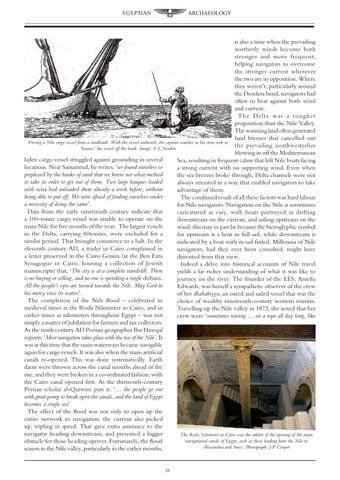
is also a time when the prevailing northerly winds become both stronger and more frequent, helping navigators to overcome the stronger current wherever the two are in opposition. Where they weren’t, particularly around the Dendera bend, navigators had often to beat against both wind and current. The Delta was a tougher proposition than the Nile Valley. The warming land often generated land breezes that cancelled out Freeing a Nile cargo vessel from a sandbank. With the vessel anchored, the captain watches as his crew seek to the prevailing northwesterlies ‘bounce’ the vessel off the bank. Image: F L Norden blowing in off the Mediterranean laden cargo vessel struggled against grounding in several Sea, resulting in frequent calms that left Nile boats facing locations. Near Samannud, he writes, ‘we found ourselves so a strong current with no supporting wind. Even when perplexed by the banks of sand that we knew not what method the sea breezes broke through, Delta channels were not to take in order to get out of them. Two large barques loaded always oriented in a way that enabled navigators to take with sena had unloaded there already a week before, without advantage of them. being able to put off. We were afraid of finding ourselves under The combined result of all these factors was hard labour a necessity of doing the same’. for Nile navigators. Navigation on the Nile is sometimes Data from the early nineteenth century indicate that caricatured as easy, with boats portrayed as drifting a 100-tonne cargo vessel was unable to operate on the downstream on the current, and sailing upstream on the main Nile for five months of the year. The largest vessels wind: this may in part be because the hieroglyphic symbol in the Delta, carrying 60tonnes, were excluded for a for upstream is a boat in full sail, while downstream is similar period. That brought commerce to a halt. In the indicated by a boat with its sail furled. Millennia of Nile eleventh century AD, a trader in Cairo complained in navigators, had they ever been consulted, might have a letter preserved in the Cairo Geniza (at the Ben Ezra dissented from that view. Synagogue in Cairo, housing a collection of Jewish Indeed a delve into historical accounts of Nile travel manuscripts) that, ‘The city is at a complete standstill. There yields a far richer understanding of what it was like to is no buying or selling, and no one is spending a single dirham. journey on the river. The founder of the EES, Amelia All the people’s eyes are turned towards the Nile. May God in Edwards, was herself a sympathetic observer of the crew his mercy raise its waters’. of her dhahabiyya, an oared and sailed vessel that was the The completion of the Nile flood – celebrated in choice of wealthy nineteenth-century western tourists. medieval times at the Roda Nilometer in Cairo, and in Travelling up the Nile valley in 1873, she noted that her earlier times at nilometers throughout Egypt – was not crew were ‘sometimes towing … on a rope all day long, like simply a matter of jubilation for farmers and tax collectors. As the tenth century AD Persian geographer Ibn Hawqal reports: ‘Most navigation takes place with the rise of the Nile’. It was at this time that the main waterways became navigable again for cargo vessels. It was also when the main artificial canals re-opened. This was done systematically. Earth dams were thrown across the canal mouths ahead of the rise, and they were broken in a co-ordinated fashion, with the Cairo canal opened first. As the thirteenth-century Persian scholar al-Qazwini puts it: ‘… the people go out with great pomp to break open the canals, and the land of Egypt becomes a single sea’. The effect of the flood was not only to open up the entire network to navigation: the current also picked up, tripling in speed. That gave extra assistance to the navigator heading downstream, and presented a bigger The Roda Nilometer in Cairo was the arbiter of the opening of the main navigational canals of Egypt, such as those leading from the Nile to obstacle for those heading upriver. Fortunately, the flood Alexandria and Suez. Photograph: J P Cooper season in the Nile valley, particularly in the earlier months, 26