EGYPTIAN
ARCHAEOLOGY
The ancient landscape around Lake Burullus
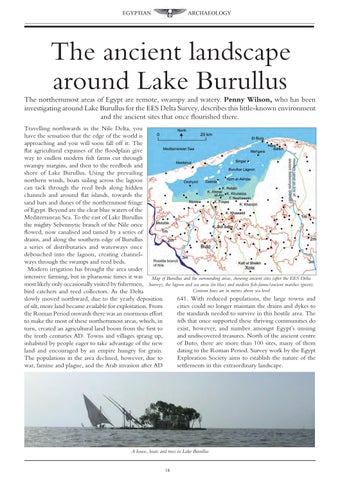
The northernmost areas of Egypt are remote, swampy and watery. Penny Wilson, who has been investigating around Lake Burullus for the EES Delta Survey, describes this little-known environment and the ancient sites that once flourished there. Travelling northwards in the Nile Delta, you have the sensation that the edge of the world is approaching and you will soon fall off it. The flat agricultural expanses of the floodplain give way to endless modern fish farms cut through swampy margins, and then to the reedbeds and shore of Lake Burullus. Using the prevailing northern winds, boats sailing across the lagoon can tack through the reed beds along hidden channels and around flat islands, towards the sand bars and dunes of the northernmost fringe of Egypt. Beyond are the clear blue waters of the Mediterranean Sea. To the east of Lake Burullus the mighty Sebennytic branch of the Nile once flowed, now canalised and tamed by a series of drains, and along the southern edge of Burullus a series of distributaries and waterways once debouched into the lagoon, creating channelways through the swamps and reed beds. Modern irrigation has brought the area under intensive farming, but in pharaonic times it was Map of Burullus and the surrounding areas, showing ancient sites (after the EES Delta most likely only occasionally visited by fishermen, Survey), the lagoon and sea areas (in blue) and modern fish-farms/ancient marshes (green). Contour lines are in metres above sea level bird catchers and reed collectors. As the Delta 641. With reduced populations, the large towns and slowly moved northward, due to the yearly deposition cities could no longer maintain the drains and dykes to of silt, more land became available for exploitation. From the standards needed to survive in this hostile area. The the Roman Period onwards there was an enormous effort tells that once supported these thriving communities do to make the most of these northernmost areas, which, in exist, however, and number amongst Egypt’s unsung turn, created an agricultural land boom from the first to and undiscovered treasures. North of the ancient centre the tenth centuries AD. Towns and villages sprang up, of Buto, there are more than 100 sites, many of them inhabited by people eager to take advantage of the new dating to the Roman Period. Survey work by the Egypt land and encouraged by an empire hungry for grain. Exploration Society aims to establish the nature of the The populations in the area declined, however, due to settlements in this extraordinary landscape. war, famine and plague, and the Arab invasion after AD
A house, boats and trees in Lake Burullus 18