EGYPTIAN
ARCHAEOLOGY
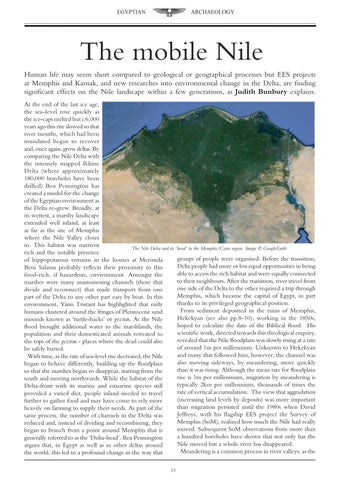
The mobile Nile Human life may seem short compared to geological or geographical processes but EES projects at Memphis and Karnak, and new researches into environmental change in the Delta, are finding significant effects on the Nile landscape within a few generations, as Judith Bunbury explains. At the end of the last ice age, the sea-level rose quickly as the ice-caps melted but c.6,000 years ago this rise slowed so that river mouths, which had been inundated began to recover and, once again, grow deltas. By comparing the Nile Delta with the intensely mapped Rhine Delta (where approximately 180,000 boreholes have been drilled) Ben Pennington has created a model for the change of the Egyptian environment as the Delta re-grew. Broadly, at its wettest, a marshy landscape extended well inland, at least as far as the site of Memphis where the Nile Valley closes in. This habitat was nutrient The Nile Delta and its ‘head’ in the Memphis/Cairo region. Image © GoogleEarth rich and the notable presence groups of people were organised. Before the transition, of hippopotamus remains in the houses at Merimda Delta people had more or less equal opportunities in being Beni Salama probably reflects their proximity to this able to access the rich habitat and were equally connected food-rich, if hazardous, environment. Amongst the to their neighbours. After the transition, river travel from marshes were many anastomosing channels (those that one side of the Delta to the other required a trip through divide and reconnect) that made transport from one Memphis, which became the capital of Egypt, in part part of the Delta to any other part easy by boat. In this thanks to its privileged geographical position. environment, Yann Tristant has highlighted that early From sediment deposited in the ruins of Memphis, humans clustered around the fringes of Pleistocene sand Hekekyan (see also pp.8-10), working in the 1850s, mounds known as ‘turtle-backs’ or geziras. As the Nile hoped to calculate the date of the Biblical flood. His flood brought additional water to the marshlands, the scientific work, directed towards this theological enquiry, population and their domesticated animals retreated to revealed that the Nile floodplain was slowly rising at a rate the tops of the geziras - places where the dead could also of around 1m per millennium. Unknown to Hekekyan be safely buried. and many that followed him, however, the channel was With time, as the rate of sea-level rise decreased, the Nile also moving sideways, by meandering, more quickly began to behave differently, building up the floodplain than it was rising. Although the mean rate for floodplain so that the marshes began to disappear, starting from the rise is 1m per millennium, migration by meandering is south and moving northwards. While the habitat of the typically 2km per millennium, thousands of times the Delta-front with its marine and estuarine species still rate of vertical accumulation. The view that aggradation provided a varied diet, people inland needed to travel (increasing land levels by deposits) was more important further to gather food and may have come to rely more than migration persisted until the 1980s when David heavily on farming to supply their needs. As part of the Jeffreys, with his flagship EES project the Survey of same process, the number of channels in the Delta was Memphis (SoM), realized how much the Nile had really reduced and, instead of dividing and recombining, they moved. Subsequent SoM observations from more than began to branch from a point around Memphis that is a hundred boreholes have shown that not only has the generally referred to as the ‘Delta-head’. Ben Pennington Nile moved but a whole river has disappeared. argues that, in Egypt as well as in other deltas around Meandering is a common process in river valleys; as the the world, this led to a profound change in the way that 15