EGYPTIAN
ARCHAEOLOGY
Sediment coring in Saqqara town (just in time!)
Coring in the fields west of Mit Rahina
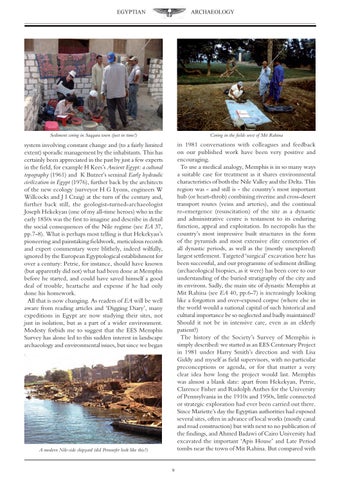
system involving constant change and (to a fairly limited extent) sporadic management by the inhabitants. This has certainly been appreciated in the past by just a few experts in the field, for example H Kees’s Ancient Egypt: a cultural topography (1961) and K Butzer’s seminal Early hydraulic civilization in Egypt (1976), further back by the architects of the new ecology (surveyor H G Lyons, engineers W Willcocks and J I Craig) at the turn of the century and, further back still, the geologist-turned-archaeologist Joseph Hekekyan (one of my all-time heroes) who in the early 1850s was the first to imagine and describe in detail the social consequences of the Nile regime (see EA 37, pp.7-8). What is perhaps most telling is that Hekekyan’s pioneering and painstaking fieldwork, meticulous records and expert commentary were blithely, indeed wilfully, ignored by the European Egyptological establishment for over a century: Petrie, for instance, should have known (but apparently did not) what had been done at Memphis before he started, and could have saved himself a good deal of trouble, heartache and expense if he had only done his homework. All that is now changing. As readers of EA will be well aware from reading articles and ‘Digging Diary’, many expeditions in Egypt are now studying their sites, not just in isolation, but as a part of a wider environment. Modesty forbids me to suggest that the EES Memphis Survey has alone led to this sudden interest in landscape archaeology and environmental issues, but since we began
in 1981 conversations with colleagues and feedback on our published work have been very positive and encouraging. To use a medical analogy, Memphis is in so many ways a suitable case for treatment as it shares environmental characteristics of both the Nile Valley and the Delta. This region was - and still is - the country’s most important hub (or heart-throb) combining riverine and cross-desert transport routes (veins and arteries), and the continual re-emergence (resuscitation) of the site as a dynastic and administrative centre is testament to its enduring function, appeal and exploitation. Its necropolis has the country’s most impressive built structures in the form of the pyramids and most extensive elite cemeteries of all dynastic periods, as well as the (mostly unexplored) largest settlement. Targeted ‘surgical’ excavation here has been successful, and our programme of sediment drilling (archaeological biopsies, as it were) has been core to our understanding of the buried stratigraphy of the city and its environs. Sadly, the main site of dynastic Memphis at Mit Rahina (see EA 40, pp.6-7) is increasingly looking like a forgotten and over-exposed corpse (where else in the world would a national capital of such historical and cultural importance be so neglected and badly maintained? Should it not be in intensive care, even as an elderly patient?) The history of the Society’s Survey of Memphis is simply described: we started as an EES Centenary Project in 1981 under Harry Smith’s direction and with Lisa Giddy and myself as field supervisors, with no particular preconceptions or agenda, or for that matter a very clear idea how long the project would last. Memphis was almost a blank slate: apart from Hekekyan, Petrie, Clarence Fisher and Rudolph Anthes for the University of Pennsylvania in the 1910s and 1950s, little connected or strategic exploration had ever been carried out there. Since Mariette’s day the Egyptian authorities had exposed several sites, often in advance of local works (mostly canal and road construction) but with next to no publication of the findings, and Ahmed Badawi of Cairo University had excavated the important ‘Apis House’ and Late Period tombs near the town of Mit Rahina. But compared with
A modern Nile-side shipyard (did Perunefer look like this?)