EGYPTIAN
ARCHAEOLOGY
Egyptian landscapes and environmental archaeology The Egypt Exploration Society’s current research strategy is focusing on landscape archaeology. David Jeffreys explains the reasons for this and the issues which need to be addressed. wandered and changed over time, not just in the Delta but also, within the confines of the desert cliffs, in the Nile Valley. Landscape/environmental archaeology can challenge and change the way we see the past and provoke questions about our own prejudices and presumptions. In particular the archaeological evidence can provide a salutary reminder that the written record is not the only one - or even the most important. There has been a surge of interest recently in the archaeology of the Egyptian landscape, both in the Nile Valley and Delta and in adjoining and peripheral regions (the deserts and oases either side, the Delta fringes, and the coasts of the Red and Mediterranean Seas). It is puzzling that it has taken so long for this interest to emerge: in the late 1890s and early 1900s Egypt’s ecology was being fundamentally transformed by the construction of the first Aswan dam and the canalisation of the country’s agricultural infrastructure, but this major event seems not to have sparked any particular enquiry into past practices. The unusual, if not unique, conditions of the Nile seem not to have struck anyone until lately. The idea had taken hold that ‘eternal Egypt’ essentially meant that things had always been the same - an extraordinarily lazy way of thinking. Nothing could be further from the truth, as we are now beginning to understand. The Nile is a dynamic riverine
Landscape archaeology is perhaps best described as the study of past natural environments and the people who lived in them. At its best it is a slightly odd combination of hard science (geology, geography, geomatics and mapping systems) and more theoretical approaches derived from social anthropology such as social history and phenomenology - the way that the environment was and is experienced in the past and the present - and certainly includes the built environment; architecture and structural history. It may address ecological and climate variations and naturally lends itself to change on a range of different timescales. One important aspect when applied to Egypt is just how conscious the Egyptians were of these changes. With the deep chronological record the Egyptians maintained we might expect this but curiously it does not seem to appear so often except in certain aspects of their mythology. The archaeology of landscapes and environmental conditions has exercised those of us interested in the way that humans have adapted to ecological change, the way that they have perceived their surroundings, and the awareness they have had over their own short- and longterm development. Environmental changes influenced, and sometimes controlled, settlement patterns in Egypt, as the annual inundation pushed the Delta out into the Mediterranean Sea and the channels of the river Nile
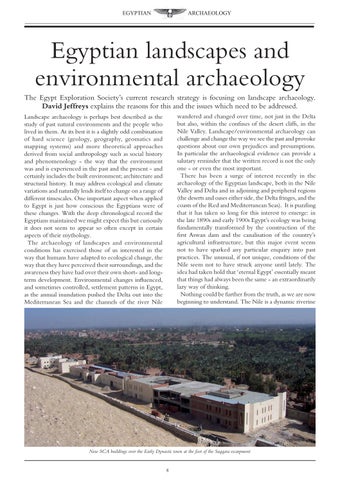
New SCA buildings over the Early Dynastic town at the foot of the Saqqara escarpment