EGYPTIAN
ARCHAEOLOGY
The first archaeological field school at Quesna In Autumn 2011 the EES, with Egyptian and German colleagues, was involved in running the first field school to be held at Quesna, where the Society has been excavating for a number of years. Joanne Rowland reports on this successful new venture. The EES mission at Quesna in Minufiyeh Governorate was very pleased to host the first archaeological field school to be held at the site, from mid-September until mid-October 2011, at the same time as the Society was also involved in training at the AERA/SCA field school at Memphis (see David Jeffreys’ article pp.5-6). Since this was the first formal field school in the governorate, the training at Quesna focused on the basic principles of excavation methodology and the recording and excavation of human skeletal remains, with introductory training on the recording of ceramic finds and conservation techniques in the field. The field school ran alongside the EES team’s season of excavation, conservation and recording at Quesna, which enabled the students to participate in all stages of the work. The trainees were seven SCA inspectors from the Delta, three students from the University of Minufiyeh Faculty of Archaeology (based in Shibin el-Kom) and two students from the Free University, Berlin. The key aim of the field school was to equip students with the basic skills necessary to approach archaeological investigation: to assess the suitability of certain locations for excavation trenches, to lay out trenches correctly, and to understand the principles of single-context excavation methodology (as based on the Museum of London system). These principles, amongst others, were
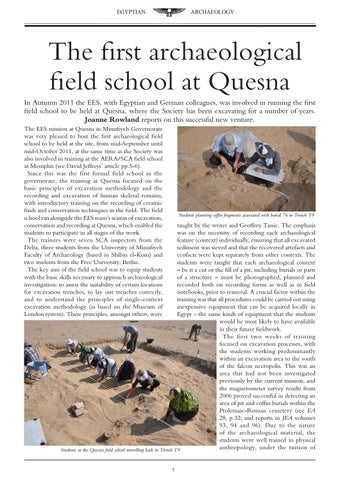
Students planning coffin fragments associated with burial 76 in Trench T9
taught by the writer and Geoffrey Tassie. The emphasis was on the necessity of recording each archaeological feature (context) individually, ensuring that all excavated sediment was sieved and that the recovered artefacts and ecofacts were kept separately from other contexts. The students were taught that each archaeological context – be it a cut or the fill of a pit, including burials or parts of a structure – must be photographed, planned and recorded both on recording forms as well as in field notebooks, prior to removal. A crucial factor within the training was that all procedures could be carried out using inexpensive equipment that can be acquired locally in Egypt - the same kinds of equipment that the students would be most likely to have available in their future fieldwork. The first two weeks of training focused on excavation processes, with the students working predominantly within an excavation area to the south of the falcon necropolis. This was an area that had not been investigated previously by the current mission, and the magnetometer survey results from 2006 proved successful in detecting an area of pit and coffin burials within the Ptolemaic-Roman cemetery (see EA 28, p.32; and reports in JEA volumes 93, 94 and 96). Due to the nature of the archaeological material, the students were well trained in physical anthropology, under the tuition of Students at the Quesna field school trowelling back in Trench T9