EGYPTIAN Head of dwarf statue, limestone. Ob No. 0660, SCA No. 55. Photo by Yasser Mahmoud.
ARCHAEOLOGY
Mit Rahina Field School 2011, Kom el-Fakhry
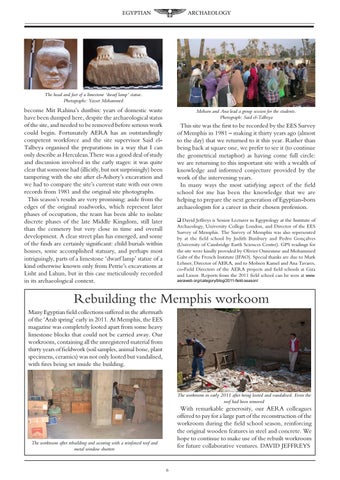
The head and feet of a limestone ‘dwarf lamp’ statue. Photographs: Yasser Mohammed
Head of dwarf statue, limestone. Ob No. 0660, SCA No. 55. Photo by Yasser Mahmoud.
Feet of dwarf statue (see above), limestone. Ob No. 0659, SCA 56. Photo by Yasser Mahmoud.
become Mit Rahina’s dustbin: years of domestic waste have been dumped here, despite the archaeological status of the site, and needed to be removed before serious work MRFS 2011 Short End-of-Season Report to the SCA. Kom el-Fakhry. could begin. Fortunately AERA has an outstandingly competent workforce and the site supervisor Said elTalbeya organised the preparations in a way that I can only describe as0659,Herculean.There Feet of dwarf statue (see above), limestone. Ob No. SCA 56. Photo by Yasser Mahmoud. was a good deal of study and discussion involved in the early stages: it was quite clear that someone had (illicitly, but not surprisingly) been tampering with the site after el-Ashery’s excavation and we had to compare the site’s current state with our own records from 1981 and the original site photographs. This season’s results are very promising: aside from the edges of the original roadworks, which represent later phases of occupation, the team has been able to isolate discrete phases of the late Middle Kingdom, still later than the cemetery but very close in time and overall development. A clear street plan has emerged, and some of the finds are certainly significant: child burials within houses, some accomplished statuary, and perhaps most intriguingly, parts of a limestone ‘dwarf lamp’ statue of a kind otherwise known only from Petrie’s excavations at Lisht and Lahun, but in this case meticulously recorded in its archaeological context. MRFS 2011 Short End-of-Season Report to the SCA. Kom el-Fakhry.
Mohsen and Ana lead a group session for the students. Photograph: Said el-Talbeya
This site was the first to be recorded by the EES Survey of Memphis in 1981 – making it thirty years ago (almost to the day) that we returned to it this year. Rather than being back at square one, we prefer to see it (to continue the geometrical metaphor) as having come full circle: we are returning to this important site with a wealth of knowledge and informed conjecture provided by the work of the intervening years. In many ways the most satisfying aspect of the field school for me has been the knowledge that we are helping to prepare the next generation of Egyptian-born archaeologists for a career in their chosen profession.
Page 12 of 14
Page 12 of 14
q David Jeffreys is Senior Lecturer in Egyptology at the Institute of Archaeology, University College London, and Director of the EES Survey of Memphis. The Survey of Memphis was also represented by at the field school by Judith Bunbury and Pedro Gonçalves (University of Cambridge Earth Sciences Centre). GPS readings for the site were kindly provided by Olivier Onnezime and Mohammed Gabr of the French Institute (IFAO). Special thanks are due to Mark Lehner, Director of AERA, and to Mohsen Kamel and Ana Tavares, co-Field Directors of the AERA projects and field schools at Giza and Luxor. Reports from the 2011 field school can be seen at www. aeraweb.org/category/blog/2011-field-season/
Rebuilding the Memphis workoom Many Egyptian field collections suffered in the aftermath of the ‘Arab spring’ early in 2011. At Memphis, the EES magazine was completely looted apart from some heavy limestone blocks that could not be carried away. Our workroom, containing all the unregistered material from thirty years of fieldwork (soil samples, animal bone, plant specimens, ceramics) was not only looted but vandalised, with fires being set inside the building.
The workroom in early 2011 after being looted and vandalised. Even the roof had been removed
With remarkable generosity, our AERA colleagues offered to pay for a large part of the reconstruction of the workroom during the field school season, reinforcing the original wooden features in steel and concrete. We hope to continue to make use of the rebuilt workroom for future collaborative ventures. DAVID JEFFREYS
The workroom after rebuilding and securing with a reinforced roof and metal window shutters