EGYPTIAN
ARCHAEOLOGY
Memphis in the Middle Kingdom: the field school In an exciting new development for the EES Survey of Memphis the Society collaborated with colleagues from AERA and the SCA to run a field school at Mit Rahina, excavating a Middle Kingdom settlement and cemetery, as David Jeffreys describes. For the first time in the thirty-year history of the Society’s Survey of Memphis, we have entered into a truly collaborative project with colleagues, and it has turned out to be a huge success. We have just taken part in a joint programme designed to train the next generation of Egyptian student inspectors, working with Ancient Egypt Research Associates (AERA) and the Supreme Council of Antiquities to run a training excavation near Mit Rahina, the town at the centre of the Memphis complex (hence the official title: Mit Rahina Field School – MRFS). AERA, under the Director Mark Lehner, and Field Directors Ana Tavares and Mohsen Kamel, has a long and honourable history of providing beginners’ and advanced field schools for young Egyptian inspectors, as well as more intensive excavation, at the ‘lost city of the pyramids’ at Giza. The Mit Rahina excavation lies just south of the town, in a locality known as Kom Fakhry (taking its name from the oldest mosque in the town, the nearby Sheikh Fakhry). The site has been previously excavated, after being exposed by roadworks in the 1950s, and again in 1981 just as the EES Survey of Memphis began. At the request of the SCA Inspector excavating the site at that time we made a full archaeological plan of the remains. The original (1954) excavation revealed a group arrangement of burials in stone-lined, brick-vaulted tombs, with a common façade on the east side lined with offering tables and fronted with two limestone false doors, dating to the First Intermediate Period or early Middle Kingdom. The finds were briefly reported in an article
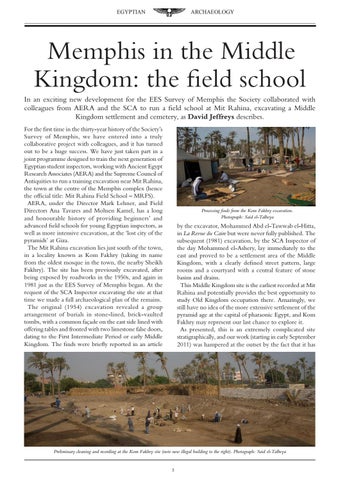
Processing finds from the Kom Fakhry excavation. Photograph: Said el-Talbeya
by the excavator, Mohammed Abd el-Tawwab el-Hitta, in La Revue du Caire but were never fully published. The subsequent (1981) excavation, by the SCA Inspector of the day Mohammed el-Ashery, lay immediately to the east and proved to be a settlement area of the Middle Kingdom, with a clearly defined street pattern, large rooms and a courtyard with a central feature of stone basins and drains. This Middle Kingdom site is the earliest recorded at Mit Rahina and potentially provides the best opportunity to study Old Kingdom occupation there. Amazingly, we still have no idea of the more extensive settlement of the pyramid age at the capital of pharaonic Egypt, and Kom Fakhry may represent our last chance to explore it. As presented, this is an extremely complicated site stratigraphically, and our work (starting in early September 2011) was hampered at the outset by the fact that it has
Preliminary cleaning and recording at the Kom Fakhry site (note new illegal building to the right). Photograph: Said el-Talbeya