EGYPTIAN
ARCHAEOLOGY
EES members visit Berlin A new venture for the EES in November 2011 saw a group of 23 members spend a few days in Berlin. We left Heathrow on Thursday 17 November and on the following afternoon met the Director, Friederike Seyfried, at the Neues Museum for a very detailed, informative and entertaining tour of the new Egyptian galleries. These include the Museum’s impressive collection of Amarna Period objects from the German excavations at the site in 1912-13, especially those from the workshop of the sculptor Tuthmose. On the Saturday we were at the EES/Free University, Berlin Delta Survey Study Day at the University’s TOPOI House research centre, for a range of talks on current fieldwork in the Delta - two of which are summarised in this issue (pp.29-33). We also had free time in Berlin and many of the group took the opportunity to visit the Pergamon Museum with its impressive large monuments - the Pergamon Altar itself, the Gate of Ishtar from Babylon and the Market Gate of Miletus. The Society is very grateful Friederike Seyfried describing an artist’s model head of Nefertiti to Dr Seyfried for giving so
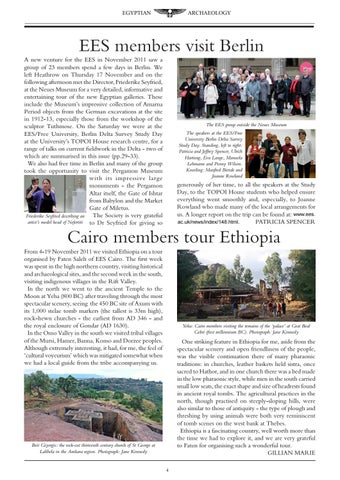
The EES group outside the Neues Museum The speakers at the EES/Free University Berlin Delta Survey Study Day. Standing, left to right: Patricia and Jeffrey Spencer, Ulrich Hartung, Eva Lange, Manuela Lehmann and Penny Wilson. Kneeling: Manfred Bietak and Joanne Rowland
generously of her time, to all the speakers at the Study Day, to the TOPOI House students who helped ensure everything went smoothly and, especially, to Joanne Rowland who made many of the local arrangements for us. A longer report on the trip can be found at: www.ees. ac.uk/news/index/148.html. PATRICIA SPENCER
Cairo members tour Ethiopia From 4-19 November 2011 we visited Ethiopia on a tour organised by Faten Saleh of EES Cairo. The first week was spent in the high northern country, visiting historical and archaeological sites, and the second week in the south, visiting indigenous villages in the Rift Valley. In the north we went to the ancient Temple to the Moon at Yeha (800 BC) after traveling through the most spectacular scenery, seeing the 450 BC site of Axum with its 1,000 stelae tomb markers (the tallest is 33m high), rock-hewn churches - the earliest from AD 346 - and the royal enclosure of Gondar (AD 1630). In the Omo Valley in the south we visited tribal villages of the Mursi, Hamer, Banna, Konso and Dorzee peoples. Although extremely interesting, it had, for me, the feel of ‘cultural voyeurism’ which was mitigated somewhat when we had a local guide from the tribe accompanying us.
Yeha: Cairo members visiting the remains of the ‘palace’ at Grat Beal Gebri (first millennium BC). Photograph: Jane Kennedy
One striking feature in Ethiopia for me, aside from the spectacular scenery and open friendliness of the people, was the visible continuation there of many pharaonic traditions: in churches, leather baskets held sistra, once sacred to Hathor, and in one church there was a bed made in the low pharaonic style, while men in the south carried small low seats, the exact shape and size of headrests found in ancient royal tombs. The agricultural practices in the north, though practised on steeply-sloping hills, were also similar to those of antiquity - the type of plough and threshing by using animals were both very reminiscent of tomb scenes on the west bank at Thebes. Ethiopia is a fascinating country, well worth more than the time we had to explore it, and we are very grateful to Faten for organising such a wonderful tour. GILLIAN MARIE
Beit Giyorgis: the rock-cut thirteenth century church of St George at Lalibela in the Amhara region. Photograph: Jane Kennedy