EGYPTIAN
ARCHAEOLOGY
Five Minutes with Neal Spencer When did you first encounter the EES?
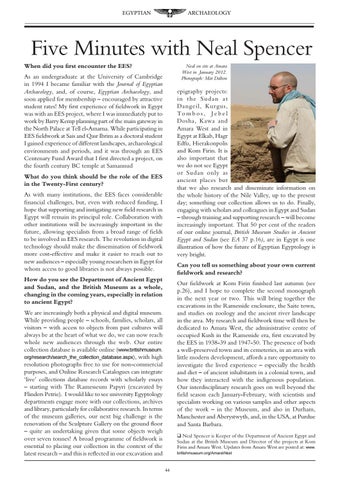
Neal on site at Amara West in January 2012. Photograph: Mat Dalton
As an undergraduate at the University of Cambridge in 1994 I became familiar with the Journal of Egyptian Archaeology, and, of course, Egyptian Archaeology, and soon applied for membership – encouraged by attractive student rates! My first experience of fieldwork in Egypt was with an EES project, where I was immediately put to work by Barry Kemp planning part of the main gateway in the North Palace at Tell el-Amarna. While participating in EES fieldwork at Sais and Qasr Ibrim as a doctoral student I gained experience of different landscapes, archaeological environments and periods, and it was through an EES Centenary Fund Award that I first directed a project, on the fourth century BC temple at Samannud
epigraphy projects: in the Sudan at Dangeil, Kurgus, To m b o s , J e b e l Dosha, Kawa and Amara West and in Egypt at Elkab, Hagr Edfu, Hierakonpolis and Kom Firin. It is also important that we do not see Egypt or Sudan only as ancient places but that we also research and disseminate information on the whole history of the Nile Valley, up to the present day; something our collection allows us to do. Finally, engaging with scholars and colleagues in Egypt and Sudan – through training and supporting research – will become increasingly important. That 50 per cent of the readers of our online journal, British Museum Studies in Ancient Egypt and Sudan (see EA 37 p.16), are in Egypt is one illustration of how the future of Egyptian Egyptology is very bright.
What do you think should be the role of the EES in the Twenty-First century? As with many institutions, the EES faces considerable financial challenges, but, even with reduced funding, I hope that supporting and instigating new field research in Egypt will remain its principal role. Collaboration with other institutions will be increasingly important in the future, allowing specialists from a broad range of fields to be involved in EES research. The revolution in digital technology should make the dissemination of fieldwork more cost-effective and make it easier to reach out to new audiences – especially young researchers in Egypt for whom access to good libraries is not always possible.
Can you tell us something about your own current fieldwork and research?
How do you see the Department of Ancient Egypt and Sudan, and the British Museum as a whole, changing in the coming years, especially in relation to ancient Egypt?
Our fieldwork at Kom Firin finished last autumn (see p.26), and I hope to complete the second monograph in the next year or two. This will bring together the excavations in the Ramesside enclosure, the Saite town, and studies on zoology and the ancient river landscape in the area. My research and fieldwork time will then be dedicated to Amara West, the administrative centre of occupied Kush in the Ramesside era, first excavated by the EES in 1938-39 and 1947-50. The presence of both a well-preserved town and its cemeteries, in an area with little modern development, affords a rare opportunity to investigate the lived experience – especially the health and diet – of ancient inhabitants in a colonial town, and how they interacted with the indigenous population. Our interdisciplinary research goes on well beyond the field season each January-February, with scientists and specialists working on various samples and other aspects of the work – in the Museum, and also in Durham, Manchester and Aberystwyth, and, in the USA, at Purdue and Santa Barbara.
We are increasingly both a physical and digital museum. While providing people – schools, families, scholars, all visitors – with access to objects from past cultures will always be at the heart of what we do, we can now reach whole new audiences through the web. Our entire collection database is available online (www.britishmuseum. org/research/search_the_collection_database.aspx), with high resolution photographs free to use for non-commercial purposes, and Online Research Catalogues can integrate ‘live’ collections database records with scholarly essays – starting with The Ramesseum Papyri (excavated by Flinders Petrie). I would like to see university Egyptology departments engage more with our collections, archives and library, particularly for collaborative research. In terms of the museum galleries, our next big challenge is the renovation of the Sculpture Gallery on the ground floor – quite an undertaking given that some objects weigh over seven tonnes! A broad programme of fieldwork is essential to placing our collection in the context of the latest research – and this is reflected in our excavation and
q Neal Spencer is Keeper of the Department of Ancient Egypt and Sudan at the British Museum and Director of the projects at Kom Firin and Amara West. Updates from Amara West are posted at: www. britishmuseum.org/AmaraWest
44