EGYPTIAN
ARCHAEOLOGY
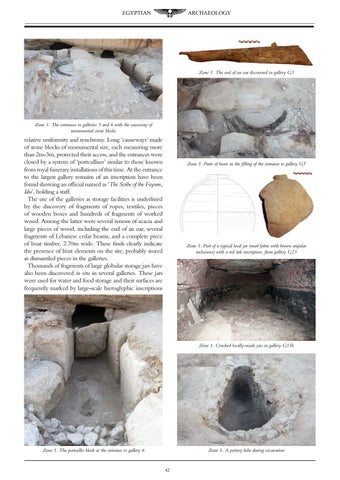
Zone 1. The end of an oar discovered in gallery G3
Zone 1. The entrances to galleries 5 and 6 with the causeway of monumental stone blocks
relative uniformity and synchrony. Long ‘causeways’ made of stone blocks of monumental size, each measuring more than 2m-3m, protected their access, and the entrances were closed by a system of ‘portcullises’ similar to those known from royal funerary installations of this time. At the entrance to the largest gallery remains of an inscription have been found showing an official named as ‘The Scribe of the Fayum, Idu’, holding a staff. The use of the galleries as storage facilities is underlined by the discovery of fragments of ropes, textiles, pieces of wooden boxes and hundreds of fragments of worked wood. Among the latter were several tenons of acacia and large pieces of wood, including the end of an oar, several fragments of Lebanese cedar beams, and a complete piece of boat timber, 2.70m wide. These finds clearly indicate the presence of boat elements on the site, probably stored as dismantled pieces in the galleries. Thousands of fragments of large globular storage jars have also been discovered in situ in several galleries. These jars were used for water and food storage and their surfaces are frequently marked by large-scale hieroglyphic inscriptions
Zone 1. Parts of boats in the filling of the entrance to gallery G5
Zone 1. Part of a typical local jar (marl fabric with brown angular inclusions) with a red ink inscription, from gallery G23
Zone 1. Crushed locally-made jars in gallery G15b
Zone 1. The portcullis block at the entrance to gallery 6
Zone 1. A pottery kiln during excavation
42