EGYPTIAN
ARCHAEOLOGY
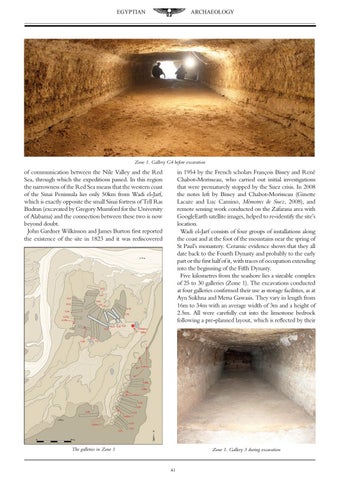
Zone 1. Gallery G4 before excavation
of communication between the Nile Valley and the Red Sea, through which the expeditions passed. In this region the narrowness of the Red Sea means that the western coast of the Sinai Peninsula lies only 50km from Wadi el-Jarf, which is exactly opposite the small Sinai fortress of Tell Ras Budran (excavated by Gregory Mumford for the University of Alabama) and the connection between these two is now beyond doubt. John Gardner Wilkinson and James Burton first reported the existence of the site in 1823 and it was rediscovered
in 1954 by the French scholars François Bissey and René Chabot-Morisseau, who carried out initial investigations that were prematurely stopped by the Suez crisis. In 2008 the notes left by Bissey and Chabot-Morisseau (Ginette Lacaze and Luc Camino, Mémoires de Suez, 2008), and remote sensing work conducted on the Zafarana area with GoogleEarth satellite images, helped to re-identify the site’s location. Wadi el-Jarf consists of four groups of installations along the coast and at the foot of the mountains near the spring of St Paul’s monastery. Ceramic evidence shows that they all date back to the Fourth Dynasty and probably to the early part or the first half of it, with traces of occupation extending into the beginning of the Fifth Dynasty. Five kilometres from the seashore lies a sizeable complex of 25 to 30 galleries (Zone 1). The excavations conducted at four galleries confirmed their use as storage facilities, as at Ayn Sukhna and Mersa Gawasis. They vary in length from 16m to 34m with an average width of 3m and a height of 2.5m. All were carefully cut into the limestone bedrock following a pre-planned layout, which is reflected by their
The galleries in Zone 1
Zone 1. Gallery 3 during excavation
41