EGYPTIAN
ARCHAEOLOGY
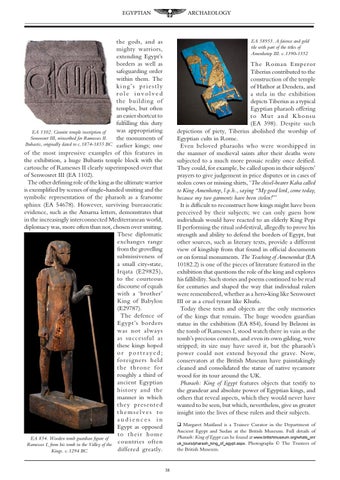
the gods, and as mighty warriors, extending Egypt’s borders as well as safeguarding order within them. The k i n g ’s p r i e s t l y role involved the building of temples, but often an easier shortcut to fulfilling this duty was appropriating EA 1102. Granite temple inscription of Senwosret III, reinscribed for Ramesses II. the monuments of Bubastis, originally dated to c.1874-1855 BC earlier kings; one of the most impressive examples of this features in the exhibition, a huge Bubastis temple block with the cartouche of Ramesses II clearly superimposed over that of Senwosret III (EA 1102). The other defining role of the king as the ultimate warrior is exemplified by scenes of single-handed smiting and the symbolic representation of the pharaoh as a fearsome sphinx (EA 54678). However, surviving bureaucratic evidence, such as the Amarna letters, demonstrates that in the increasingly interconnected Mediterranean world, diplomacy was, more often than not, chosen over smiting. These diplomatic exchanges range from the grovelling submissiveness of a small city-state, Irqata (E29825), to the courteous discourse of equals with a ‘brother’ King of Babylon (E29787). The defence of Egypt’s borders was not always as successful as these kings hoped or portrayed; foreigners held the throne for roughly a third of ancient Egyptian history and the manner in which they pr esented themselves to audiences in Egypt as opposed to their home EA 854. Wooden tomb guardian figure of countries often Ramesses I, from his tomb in the Valley of the differed greatly. Kings. c.1294 BC
EA 58953. A faience and gold tile with part of the titles of Amenhotep III. c.1390-1352
The Roman Emperor Tiberius contributed to the construction of the temple of Hathor at Dendera, and a stela in the exhibition depicts Tiberius as a typical Egyptian pharaoh offering to Mut and Khonsu (EA 398). Despite such depictions of piety, Tiberius abolished the worship of Egyptian cults in Rome. Even beloved pharaohs who were worshipped in the manner of medieval saints after their deaths were subjected to a much more prosaic reality once deified. They could, for example, be called upon in their subjects’ prayers to give judgement in price disputes or in cases of stolen cows or missing shirts, ‘The chisel-bearer Kaha called to King Amenhotep, l.p.h., saying “My good lord, come today, because my two garments have been stolen!”’ It is difficult to reconstruct how kings might have been perceived by their subjects; we can only guess how individuals would have reacted to an elderly King Pepi II performing the ritual sed-festival, allegedly to prove his strength and ability to defend the borders of Egypt, but other sources, such as literary texts, provide a different view of kingship from that found in official documents or on formal monuments. The Teaching of Amenemhat (EA 10182.2) is one of the pieces of literature featured in the exhibition that questions the role of the king and explores his fallibility. Such stories and poems continued to be read for centuries and shaped the way that individual rulers were remembered, whether as a hero-king like Senwosret III or as a cruel tyrant like Khufu. Today these texts and objects are the only memories of the kings that remain. The huge wooden guardian statue in the exhibition (EA 854), found by Belzoni in the tomb of Ramesses I, stood watch there in vain as the tomb’s precious contents, and even its own gilding, were stripped; its size may have saved it, but the pharaoh’s power could not extend beyond the grave. Now, conservators at the British Museum have painstakingly cleaned and consolidated the statue of native sycamore wood for its tour around the UK. Pharaoh: King of Egypt features objects that testify to the grandeur and absolute power of Egyptian kings, and others that reveal aspects, which they would never have wanted to be seen, but which, nevertheless, give us greater insight into the lives of these rulers and their subjects. q Margaret Maitland is a Trainee Curator in the Department of Ancient Egypt and Sudan at the British Museum. Full details of Pharaoh: King of Egypt can be found at www.britishmuseum.org/whats_on/ uk_tours/pharaoh_king_of_egypt.aspx. Photographs © The Trustees of the British Museum.
38