EGYPTIAN
ARCHAEOLOGY
Pharaoh: ideal and reality A current British Museum exhibition, which is touring museums in the United Kingdom, explores the nature of kingship in ancient Egypt over 3,000 years of history, illustrated by many major pieces from the national collection, as Margaret Maitland describes. ‘The sun god Ra placed (the) King in the land of the living for eternity and all time; for judging men, for making gods content, for creating truth, for destroying evil’ – the King as Sun-priest (EA 9953B.1).
Some rulers felt justified in erasing their predecessors from history when they did not fit with the standard ideals of kingship; the extent of the official persecution of the female pharaoh Hatshepsut is visible from the defaced cartouches on several monuments in the exhibition, including her joint stela with Tuthmosis III found as far south as the Second Cataract (EA 1131). Although a number of Egyptian texts refer to the king as having ruled ‘from the egg’, numerous pharaohs came to the throne unexpectedly as either younger sons, brothers, female relatives, usurpers or invaders. One of the objects in the exhibition – a door jamb from the tomb of Horemheb at Saqqara (EA 552) – demonstrates that after his accession to the throne, Tutankhamun’s former army general was not satisfied with building a new royal tomb for himself in the Valley of the Kings; he also felt the need to edit his original private tomb by adding royal uraei to his depictions there. The royal duties which gave kings their purpose were highly idealised: to act as pious priests, devoted to serving
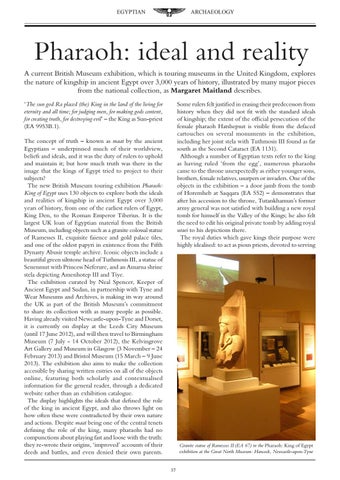
The concept of truth – known as maat by the ancient Egyptians – underpinned much of their worldview, beliefs and ideals, and it was the duty of rulers to uphold and maintain it; but how much truth was there in the image that the kings of Egypt tried to project to their subjects? The new British Museum touring exhibition Pharaoh: King of Egypt uses 130 objects to explore both the ideals and realities of kingship in ancient Egypt over 3,000 years of history, from one of the earliest rulers of Egypt, King Den, to the Roman Emperor Tiberius. It is the largest UK loan of Egyptian material from the British Museum, including objects such as a granite colossal statue of Ramesses II, exquisite faience and gold palace tiles, and one of the oldest papyri in existence from the Fifth Dynasty Abusir temple archive. Iconic objects include a beautiful green siltstone head of Tuthmosis III, a statue of Senenmut with Princess Neferure, and an Amarna shrine stela depicting Amenhotep III and Tiye. The exhibition curated by Neal Spencer, Keeper of Ancient Egypt and Sudan, in partnership with Tyne and Wear Museums and Archives, is making its way around the UK as part of the British Museum’s commitment to share its collection with as many people as possible. Having already visited Newcastle-upon-Tyne and Dorset, it is currently on display at the Leeds City Museum (until 17 June 2012), and will then travel to Birmingham Museum (7 July - 14 October 2012), the Kelvingrove Art Gallery and Museum in Glasgow (3 November – 24 February 2013) and Bristol Museum (15 March – 9 June 2013). The exhibition also aims to make the collection accessible by sharing written entries on all of the objects online, featuring both scholarly and contextualised information for the general reader, through a dedicated website rather than an exhibition catalogue. The display highlights the ideals that defined the role of the king in ancient Egypt, and also throws light on how often these were contradicted by their own nature and actions. Despite maat being one of the central tenets defining the role of the king, many pharaohs had no compunctions about playing fast and loose with the truth: they re-wrote their origins, ‘improved’ accounts of their deeds and battles, and even denied their own parents.
Granite statue of Ramesses II (EA 67) in the Pharaoh: King of Egypt exhibition at the Great North Museum: Hancock, Newcastle-upon-Tyne
37