EGYPTIAN
had arthritic changes in the cervical vertebrae, knees and feet, and his scans also highlighted bone demineralisation. The scanning revealed some of the differences which occurred in high-quality mummification procedures over the period of about 400 years which separated the lives of these two men. Seramun’s brain had been extracted via the nasal passage in the classic manner described by Herodotus, and his body cavity eviscerated through an incision in the left flank; the preserved heart could not be located by the CT scanner but four packages of viscera, each accompanied by a wax figure of one of the Sons of Horus, were detected. Artificial eyes had been inserted into the sockets to replace the desiccated eyes, and packing materials had been pushed under the skin of the face, neck and penis to restore these crucial body-parts to a lifelike appearance. Typical of Twenty-First Dynasty mummification, several objects were placed within the wrappings – an amuletic necklace, a heart scarab, a winged pectoral plate of metal and a wax figure of the mythical benu bird. Advances in the technology of CT scanning now enable clear 3-D reconstructions of these small objects to be made, even registering the incised inscriptions on the base of the heart scarab. Reliable information about the distribution of such funerary trappings on the mummified body is still scarce, so the documentation of Seramun’s amulets in situ is one of this project’s most valuable contributions to knowledge. The embalmers who treated Ankhpakhered’s body about four centuries later also removed his brain, but this time via the foramen magnum at the base of the skull – a less common alternative to the nasal route. The liver, lungs, stomach and intestines were extracted via the usual left flank incision. Although the scanner revealed packages located within the body cavity, the dense granular material inside them appears not to contain the desiccated organs but perhaps instead natron used to absorb the body’s fluids. In this mummy too the all-important heart was missing, and in its place was a resin-soaked bundle of cloth, perhaps placed there to act as a symbolic substitute for the organ. No amulets were placed under Ankhpakhered’s bandages but a winged scarab and figures of the Sons of Horus were threaded into a network of faience beads which was laid over his outer wrappings. The second part of the book is a catalogue of the exhibition, consisting mostly of small objects – figures of deities, the trappings of the mummy (bandages, fragments of coffins and cartonnage) and tomb equipment, such as stelae, an offering table, canopic jars, shabtis, a funerary cone, a New Year flask and a scribal palette. The majority are objects of common types; the most striking is the beautiful calcite canopic jar of Ptahmose, one of two men of that name who held the post of High Priest of Ptah in the middle years of the Eighteenth Dynasty. This piece, part of the collection at Chateau-Gontier, serves as a reminder that the smaller museums of France hold many wonderful artefacts that deserve to be better known. JOHN H TAYLOR
ARCHAEOLOGY
Ivor Noël Hume, Belzoni: The Giant Archaeologists Love to Hate. University of Virginia Press, Charlottesville, 2011 (ISBN 978 0 8139 3140 1). Price: $34.95. It is over half a century since the last good book on Giovanni Belzoni was published (Stanley Mayes, The Great Belzoni, 1959). Here, written by a noted archaeologist and former Director of Colonial Williamsburg’s archaeological research programme, is a splendid and upto-date story of the, literally, giant (2m tall) pioneer Egyptologist. Many writers of recent years have had a tendency to denigrate Belzoni and his achievements, but Howard Carter noted that his work in the Valley of the Kings was the first large scale excavations there, and said ‘we must give Belzoni full credit for the manner in which they were carried out … on the whole the work was extraordinarily good’. Belzoni’s detractors often fail to recognise the ethos of the time in which he worked, and they should not judge him by modern standards. Noël Hume’s new biography puts Belzoni firmly in his place as a pioneer who really thought about his discoveries – he was no rabid collector like
his rival Drovetti, without any thought for interpretation or context. From humble beginnings in Padua via the fairgrounds of Europe fate cast him into Egypt where, against all initial adversities, he found a calling and followed it. Some of the finest sculptures in the British Museum, notably the colossal 7½ ton head of Ramesses II, together with the sarcophagus of Seti I in Sir John Soane’s Museum and the lid of the sarcophagus of Ramesses III in Cambridge are all due to his endeavours. Added to that, he retrieved for William John Bankes the Philae obelisk (now at Kingston Lacy) whose inscription was to be vital in Champollion’s decipherment of hieroglyphs in 1822. He was the first European to enter the Second Pyramid at Giza, and the first to find the entrance to the Great Temple at Abu Simbel and, five years before Champollion deciphered hieroglyphs, he realised that the ‘hero’ depicted on the walls there was the same as the one he had seen in Thebes - Ramesses II. Noël Hume brings Belzoni, and the world in which he carried out his explorations, to life in his own words, and adds much new insight into that life as well as his own pertinent observations. He particularly puts more flesh onto the person of Belzoni’s long-suffering but devoted wife, Sarah. It is often remarked that on excavations the best finds turn up on the last day, and Noël Hume has been similarly bedevilled. Belzoni died at Gato in Benin in 1823, and Sarah in Jersey in January 1870. Mayes (1959) did not know where she was buried and both Noël Hume and the reviewer (unbeknownst to each other) have for years been trying to locate her grave via Jersey local newspapers, radio and personal contact, to no avail. As, literally, the book was finished and published word came that her grave and inscribed tombstone had been found (see below). Now the chase is on for details of who provided for her burial, and how. Egyptological research, even after a couple of centuries, always has surprises and goals to pursue. PETER A CLAYTON
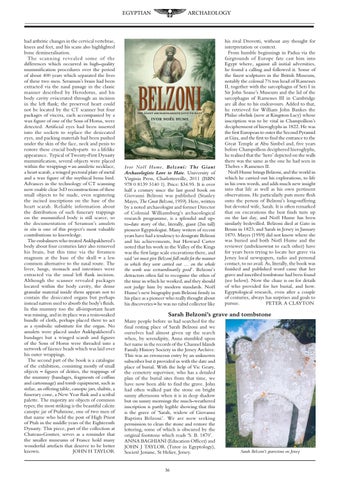
Sarah Belzoni’s grave and tombstone Many people before us had searched for the final resting place of Sarah Belzoni and we ourselves had almost given up the search when, by serendipity, Anna stumbled upon her name in the records of the Channel Islands Family History Society in the Jersey Archive. This was an erroneous entry by an unknown subscriber but it provided us with the date and place of burial. With the help of Vic Geary, the cemetery supervisor, who has a detailed plan of the burial sites from that time, we have now been able to find the grave. John had often walked past the stone on bright sunny afternoons when it is in deep shadow but on sunny mornings the much-weathered inscription is partly legible showing that this is the grave of ‘Sarah, widow of Giovanni Baptista Belzoni’. We are now seeking permission to clean the stone and restore the lettering, some of which is obscured by the original footstone which reads ‘S. B. 1870’. ANNA BAGHIANI (Education Officer) and JOHN J TAYLOR (Tutor in Egyptology), Societé Jeriaise, St Helier, Jersey.
36
Sarah Belzoni’s gravestone on Jersey