EGYPTIAN
ARCHAEOLOGY
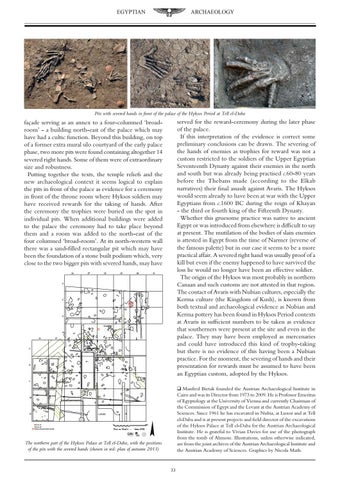
Pits with severed hands in front of the palace of the Hyksos Period at Tell el-Daba
served for the reward-ceremony during the later phase of the palace. If this interpretation of the evidence is correct some preliminary conclusions can be drawn. The severing of the hands of enemies as trophies for reward was not a custom restricted to the soldiers of the Upper Egyptian Seventeenth Dynasty against their enemies in the north and south but was already being practised c.60-80 years before the Thebans made (according to the Elkab narratives) their final assault against Avaris. The Hyksos would seem already to have been at war with the Upper Egyptians from c.1600 BC during the reign of Khayan - the third or fourth king of the Fifteenth Dynasty. Whether this gruesome practice was native to ancient Egypt or was introduced from elsewhere is difficult to say at present. The mutilation of the bodies of slain enemies is attested in Egypt from the time of Narmer (reverse of the famous palette) but in our case it seems to be a more practical affair. A severed right hand was usually proof of a kill but even if the enemy happened to have survived the loss he would no longer have been an effective soldier. The origin of the Hyksos was most probably in northern Canaan and such customs are not attested in that region. The contact of Avaris with Nubian cultures, especially the Kerma culture (the Kingdom of Kush), is known from both textual and archaeological evidence as Nubian and Kerma pottery has been found in Hyksos Period contexts at Avaris in sufficient numbers to be taken as evidence that southerners were present at the site and even in the palace. They may have been employed as mercenaries and could have introduced this kind of trophy-taking but there is no evidence of this having been a Nubian practice. For the moment, the severing of hands and their presentation for rewards must be assumed to have been an Egyptian custom, adopted by the Hyksos.
façade serving as an annex to a four-columned ‘broadroom’ - a building north-east of the palace which may have had a cultic function. Beyond this building, on top of a former extra mural silo courtyard of the early palace phase, two more pits were found containing altogether 14 severed right hands. Some of them were of extraordinary size and robustness. Putting together the texts, the temple reliefs and the new archaeological context it seems logical to explain the pits in front of the palace as evidence for a ceremony in front of the throne room where Hyksos soldiers may have received rewards for the taking of hands. After the ceremony the trophies were buried on the spot in individual pits. When additional buildings were added to the palace the ceremony had to take place beyond them and a room was added to the north-east of the four columned ‘broad-room’. At its north-western wall there was a sand-filled rectangular pit which may have been the foundation of a stone built podium which, very close to the two bigger pits with severed hands, may have 27
26
28
29
31
30
E
F
G
TEMPLE?
H 24
25
THRONEROOM
J
KX1
KX2
K GATE KX3
L
MAGAZINES
KX1
q Manfred Bietak founded the Austrian Archaeological Institute in Cairo and was its Director from 1973 to 2009. He is Professor Emeritus of Egyptology at the University of Vienna and currently Chairman of the Commission of Egypt and the Levant at the Austrian Academy of Sciences. Since 1961 he has excavated in Nubia, at Luxor and at Tell el-Daba and is at present project- and field director of the excavations of the Hyksos Palace at Tell el-Daba for the Austrian Archaeological Institute. He is grateful to Vivian Davies for use of the photograph from the tomb of Ahmose. Illustrations, unless otherwise indicated, are from the joint archives of the Austrian Archaeological Institute and the Austrian Academy of Sciences. Graphics by Nicola Math.
KX2
M
Q04
N
COURT
Phase Str. c/1 Phase Str. c/2 Position of the pits with the cut hands
20m
0
TELL EL DABCA -
AREA F/II
The northern part of the Hyksos Palace at Tell el-Daba, with the positions of the pits with the severed hands (shown in red: plan of autumn 2011)
33