EGYPTIAN
ARCHAEOLOGY
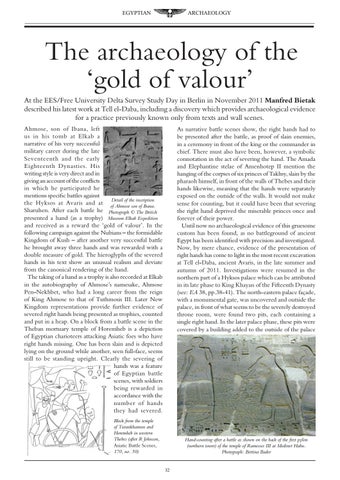
The archaeology of the ‘gold of valour’ At the EES/Free University Delta Survey Study Day in Berlin in November 2011 Manfred Bietak described his latest work at Tell el-Daba, including a discovery which provides archaeological evidence for a practice previously known only from texts and wall scenes. Ahmose, son of Ibana, left us in his tomb at Elkab a narrative of his very successful military career during the late Seventeenth and the early Eighteenth Dynasties. His writing style is very direct and in giving an account of the conflicts in which he participated he mentions specific battles against Detail of the inscription the Hyksos at Avaris and at of Ahmose son of Ibana. Sharuhen. After each battle he Photograph © The British presented a hand (as a trophy) Museum Elkab Expedition and received as a reward the ‘gold of valour’. In the following campaign against the Nubians – the formidable Kingdom of Kush – after another very successful battle he brought away three hands and was rewarded with a double measure of gold. The hieroglyphs of the severed hands in his text show an unusual realism and deviate from the canonical rendering of the hand. The taking of a hand as a trophy is also recorded at Elkab in the autobiography of Ahmose’s namesake, Ahmose Pen-Nekhbet, who had a long career from the reign of King Ahmose to that of Tuthmosis III. Later New Kingdom representations provide further evidence of severed right hands being presented as trophies, counted and put in a heap. On a block from a battle scene in the Theban mortuary temple of Horemheb is a depiction of Egyptian charioteers attacking Asiatic foes who have right hands missing. One has been slain and is depicted lying on the ground while another, seen full-face, seems still to be standing upright. Clearly the severing of hands was a feature of Egyptian battle scenes, with soldiers being rewarded in accordance with the number of hands they had severed.
As narrative battle scenes show, the right hands had to be presented after the battle, as proof of slain enemies, in a ceremony in front of the king or the commander in chief. There must also have been, however, a symbolic connotation in the act of severing the hand. The Amada and Elephantine stelae of Amenhotep II mention the hanging of the corpses of six princes of Takhsy, slain by the pharaoh himself, in front of the walls of Thebes and their hands likewise, meaning that the hands were separately exposed on the outside of the walls. It would not make sense for counting, but it could have been that severing the right hand deprived the miserable princes once and forever of their power. Until now no archaeological evidence of this gruesome custom has been found, as no battleground of ancient Egypt has been identified with precision and investigated. Now, by mere chance, evidence of the presentation of right hands has come to light in the most recent excavation at Tell el-Daba, ancient Avaris, in the late summer and autumn of 2011. Investigations were resumed in the northern part of a Hyksos palace which can be attributed in its late phase to King Khayan of the Fifteenth Dynasty (see: EA 38, pp.38-41). The north-eastern palace façade, with a monumental gate, was uncovered and outside the palace, in front of what seems to be the severely destroyed throne room, were found two pits, each containing a single right hand. In the later palace phase, these pits were covered by a building added to the outside of the palace
Block from the temple of Tutankhamun and Horemheb in western Thebes (after R Johnson, Asiatic Battle Scenes, 170, no. 50)
Hand-counting after a battle as shown on the back of the first pylon (northern tower) of the temple of Ramesses III at Medinet Habu. Photograph: Bettina Bader
32