EGYPTIAN
ARCHAEOLOGY
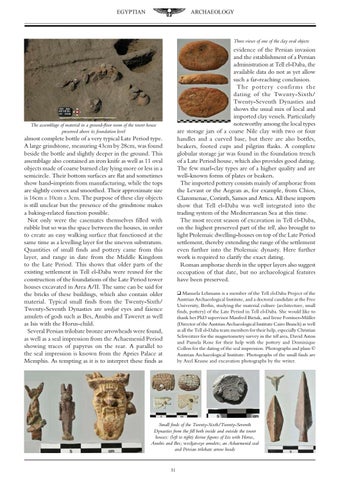
Three views of one of the clay oval objects
evidence of the Persian invasion and the establishment of a Persian administration at Tell el-Daba, the available data do not as yet allow such a far-reaching conclusion. The pottery confirms the dating of the Twenty-Sixth/ Twenty-Seventh Dynasties and shows the usual mix of local and imported clay vessels. Particularly noteworthy among the local types are storage jars of a coarse Nile clay with two or four handles and a curved base, but there are also bottles, beakers, footed cups and pilgrim flasks. A complete globular storage jar was found in the foundation trench of a Late Period house, which also provides good dating. The few marl-clay types are of a higher quality and are well-known forms of plates or beakers. The imported pottery consists mainly of amphorae from the Levant or the Aegean as, for example, from Chios, Clazomenae, Corinth, Samos and Attica. All these imports show that Tell el-Daba was well integrated into the trading system of the Mediterranean Sea at this time. The most recent season of excavation in Tell el-Daba, on the highest preserved part of the tell, also brought to light Ptolemaic dwelling-houses on top of the Late Period settlement, thereby extending the range of the settlement even further into the Ptolemaic dynasty. Here further work is required to clarify the exact dating. Roman amphorae sherds in the upper layers also suggest occupation of that date, but no archaeological features have been preserved.
The assemblage of material in a ground-floor room of the tower house preserved above its foundation level
almost complete bottle of a very typical Late Period type. A large grindstone, measuring 43cm by 28cm, was found beside the bottle and slightly deeper in the ground. This assemblage also contained an iron knife as well as 11 oval objects made of coarse burned clay lying more or less in a semicircle. Their bottom surfaces are flat and sometimes show hand-imprints from manufacturing, while the tops are slightly convex and smoothed. Their approximate size is 16cm x 10cm x 3cm. The purpose of these clay objects is still unclear but the presence of the grindstone makes a baking-related function possible. Not only were the casemates themselves filled with rubble but so was the space between the houses, in order to create an easy walking surface that functioned at the same time as a levelling layer for the uneven substratum. Quantities of small finds and pottery came from this layer, and range in date from the Middle Kingdom to the Late Period. This shows that older parts of the existing settlement in Tell el-Daba were reused for the construction of the foundations of the Late Period tower houses excavated in Area A/II. The same can be said for the bricks of these buildings, which also contain older material. Typical small finds from the Twenty-Sixth/ Twenty-Seventh Dynasties are wedjat eyes and faience amulets of gods such as Bes, Anubis and Taweret as well as Isis with the Horus-child. Several Persian trilobate bronze arrowheads were found, as well as a seal impression from the Achaemenid Period showing traces of papyrus on the rear. A parallel to the seal impression is known from the Apries Palace at Memphis. As tempting as it is to interpret these finds as
q Manuela Lehmann is a member of the Tell el-Daba Project of the Austrian Archaeological Institute, and a doctoral candidate at the Free University, Berlin, studying the material culture (architecture, small finds, pottery) of the Late Period in Tell el-Daba. She would like to thank her PhD supervisor Manfred Bietak, and Irene Forstner-Mßller (Director of the Austrian Archaeological Institute Cairo Branch) as well as all the Tell el-Daba team members for their help, especially Christian Schweitzer for the magnetometry survey in the tell area, David Aston and Pamela Rose for their help with the pottery and Dominique Collon for the dating of the seal impression. Photographs and plans Š Austrian Archaeological Institute. Photographs of the small finds are by Axel Krause and excavation photographs by the writer.
Small finds of the Twenty-Sixth/Twenty-Seventh Dynasties from the fill both inside and outside the tower houses: (left to right) divine figures of Isis with Horus, Anubis and Bes; wedjat-eye amulets; an Achaemenid seal and Persian trilobate arrow heads
31