EGYPTIAN
ARCHAEOLOGY
The city of Avaris after the New Kingdom The site of ancient Avaris at Tell el-Daba is well known as Egypt’s capital under the Hyksos rulers and as a major city in the Middle and New Kingdoms. At the EES/Free University, Berlin Study Day in November 2011 Manuela Lehmann reported on investigations of the site’s later history. walls built as a grid, and the spaces between the walls being filled with rubble. The ground plan of the mudbrick buildings is usually square or slightly rectangular. This type of solid foundation can support several storeys, and such structures are often referred to as ‘tower houses’ - a building type which was still in use in Ptolemaic and Roman times. Several preserved examples are known, for instance from Soknopaiou Nesos, Karanis and Elephantine. However, tower houses from the Late Period are not as well preserved and their remains consist mainly of the casemate foundations. Examples are attested in the Delta at sites such as Tell Balamun, Nebesheh, Buto (see pp.14-17) and Mendes. Another source of information for the appearance of tower houses is given by models of such houses, which are usually dated to the Late or Ptolemaic Periods. They are made of stone or terracotta and show a square groundplan with up to five or six storeys. They have a flat roof, square windows with a window grille and slightly concave brick courses. The ancient term - πύργος - for a tower house or watchtower is attested in many Greek papyri from Ptolemaic times. In 2009 new excavations in Area A/II on the main tell at Daba shed light on the structure of one of these
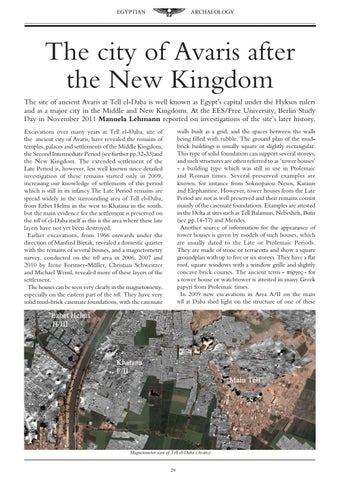
Excavations over many years at Tell el-Daba, site of the ancient city of Avaris, have revealed the remains of temples, palaces and settlements of the Middle Kingdom, the Second Intermediate Period (see further pp.32-33)and the New Kingdom. The extended settlement of the Late Period is, however, less well known since detailed investigation of these remains started only in 2009, increasing our knowledge of settlements of this period which is still in its infancy.The Late Period remains are spread widely in the surrounding area of Tell el-Daba, from Ezbet Helmi in the west to Khatana in the south, but the main evidence for the settlement is preserved on the tell of el-Daba itself as this is the area where these late layers have not yet been destroyed. Earlier excavations, from 1966 onwards under the direction of Manfred Bietak, revealed a domestic quarter with the remains of several houses, and a magnetometry survey, conducted on the tell area in 2006, 2007 and 2010 by Irene Forstner-Müller, Christian Schweitzer and Michael Weissl, revealed more of these layers of the settlement. The houses can be seen very clearly in the magnetometry, especially on the eastern part of the tell. They have very solid mud-brick casemate foundations, with the casemate
Magnetometer scan of Tell el-Daba (Avaris)
29