EGYPTIAN
first court. Stonemason Frank Helmholz and the Chicago House workmen successfully dismantled the last courses of the sandstone Domitian gate threatened with collapse due to groundwater salt decay of the lowest courses – and will start shaping replacement blocks and constructing a new, reinforced concrete foundation for the gate in the new year. http://oi.uchicago.edu/research/projects/epi/. Armant: The joint mission of IFAO/CNRSUniv Montpellier 3, directed by Christophe Thiers (CNRS, USR 3172-CFEETK), continued the archaeological survey. Beneath the kom of debris above the area of the pronaos many loose blocks were uncovered, some of them with great interest for the history of the temple from the MK to the GR period. In the E part of the pronaos, a large number of blocks was found, most of them in good condition. Noteworthy are blocks with the name of the Emperor Hadrian. Sébastien Biston-Moulin (USR 3172-CFEETK) continued the epigraphic survey of the reused and loose NK blocks (Ahmose, Hatshepsut, Tuthmosis III, Amenhotep II). With the help of Hassan elAmir (restorer, IFAO), it was possible to remove one well-preserved block from the foundation - it shows Tuthmosis III facing a goddess ‘the daughter of Ra, who lives in Armant’. After cleaning, the E part of the pronaos was uncovered and it was possible to see NK blocks, including large architraves, beneath the ones already known in this area. Reused blocks bearing the dedicatory inscription of the upper part of the pylon in the name of Ramesses I were recorded. Hassan elAmir continued the restoration programme of the scattered blocks. The lion-gargoyle and the huge architrave of Cleopatra VII were moved for their protection. Scattered sandstone blocks and many blocks uncovered during the cleaning of the kom of debris were restored, with a silicate treatment. http://recherche.univ-montp3.fr/egyptologie/ermant/.
Tell Edfu: The OI mission, led by Nadine Moeller and Gregory Marouard, focused on finishing the excavation of a late MK administrative building complex. It has been possible to confirm the presence of a second columned hall, N of the previous one, which seems to have been one of the principal features of this building. Here c.330 new mud sealings, all of them from the same layer, have been found - 44 show the cartouche of the Hyksos king Khayan and nine name Sobekhotep IV. Two new areas have been prepared for future excavation: a large area with OK settlement remains near the N-E side of the tell, close to the Ptolemaic temple, and several FIP and early MK granaries and buildings built along the inside of the town wall along the N end of the site. El-Ghonameya: The OI Tell Edfu team, led
ARCHAEOLOGY
document blocks deriving from the NK temple of Khnum, focusing on the polygonal columns of the festival court of Amenhotep II. Study of Arabic ostraca confirms for the first time an Islamic population on the island in the eighth/ ninth centuries AD. The Swiss team continued investigating the town wall and excavation of houses from the Late Antique Period. Rebuilding of the Roman temple of Osiris-Nesmeti began. www.dainst.org/en/project/elephantine?ft=all
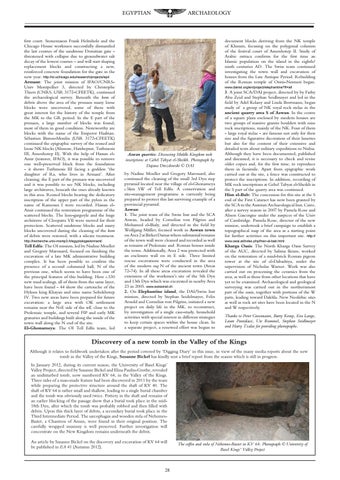
Aswan quarries: Discussing Middle Kingdom rock inscriptions at Gebel Tabyat el-Sheikh. Photograph by Dajana Drozdowski © DAI by Nadine Moeller and Gregory Marouard, also continued the cleaning of the small 3rd Dyn step pyramid located near the village of el-Ghonameya c.5km SW of Tell Edfu. A conservation and site-management programme is currently being prepared to protect this last surviving example of a provincial pyramid. Aswan: 1. The joint team of the Swiss Inst and the SCA Aswan, headed by Cornelius von Pilgrim and Mohamed el-Bialy, and directed in the field by Wolfgang Müller, focused work in Aswan town on Area 2 at Birket Damas where substantial remains of the town wall were cleaned and recorded as well as remains of Ptolemaic and Roman houses inside the town. Additionally, Area 2 was protected with an enclosure wall on its E side. Three limited rescue excavations were conducted in the area of the modern suq N of the ancient town (Areas 72-74). In all these areas excavation revealed the extension of the workmen’s site of the 5th Dyn and 13th Dyn which was excavated in nearby Area 23 in 2005. www.swissinst.ch 2. On Elephantine island, the DAI/Swiss Inst mission, directed by Stephan Seidelmayer, Felix Arnold and Cornelius von Pilgrim, initiated a new project on daily life in the MK, to reconstruct, by investigation of a single case-study, household activities with special interest in different strategies to keep certain spaces within the house clean. In a separate project, a renewed effort was begun to
3. A joint SCA/DAI project, directed by by Fathy Abu Zeid and Stephan Seidlmayer and led in the field by Adel Kelany and Linda Borrmann, began study of a group of NK royal rock stelae in the ancient quarry area S of Aswan. In the centre of a square plaza enclosed by modern houses are two groups of massive granite boulders with nine rock inscriptions, mainly of the NK. Four of them - large royal stelae - are famous not only for their size and the figurative decoration of their lunettes but also for the content of their extensive and detailed texts about military expeditions to Nubia. Although they have been documented, published and discussed, it is necessary to check and revise older copies and, for the first time, to reproduce them in facsimile. Apart from epigraphic work carried out at the site, a fence was constructed to protect the inscriptions. In addition, recording of MK rock inscriptions at Gebel Tabyat el-Sheikh in the S part of the quarry area was continued. Hisn el-Bab: The concession for this site at the S end of the First Cataract has now been granted by the SCA to the Austrian Archaeological Inst, Cairo, after a survey season in 2007 by Pamela Rose and Alison Gascoigne under the auspices of the Univ of Cambridge. Pamela Rose, director of the new mission, undertook a brief campaign to establish a topographical map of the area as a starting point for further activities on this important site. http:// www.oeai.at/index.php/hisn-al-bab.html
Kharga Oasis: The North Kharga Oasis Survey of the AUC, directed by Salima Ikram, worked on the restoration of a mud-brick Roman pigeon tower at the site of el-Dabashiya, under the supervision of Nicholas Warner. Work was also carried out on processing the ceramics from the area, as well as those from other locations that have yet to be examined. Archaeological and geological surveying was carried out in the northernmost part of the oasis, together with portions of the W parts, leading toward Dakhla. New Neolithic sites as well as rock art sites have been located in the N and W respectively. Thanks to Peter Grossmann, Barry Kemp, Eva Lange, Laure Pantalacci, Ute Rummel, Stephan Seidlmayer and Harry Tzalas for providing photographs.
Discovery of a new tomb in the Valley of the Kings Although it relates to fieldwork undertaken after the period covered by ‘Digging Diary’ in this issue, in view of the many media reports about the new tomb in the Valley of the Kings, Susanne Bickel has kindly sent a brief report from the season which is still in progress. In January 2012, during its current season, the University of Basel Kings’ Valley Project, directed by Susanne Bickel and Elina Paulin-Grothe, revealed an undisturbed tomb, now numbered KV 64, in the Valley of the Kings. Three sides of a man-made feature had been discovered in 2011 by the team while preparing the protective structure around the shaft of KV 40. The shaft of KV 64 is rather small and shallow, leading to a single burial chamber and the tomb was obviously used twice. Pottery in the shaft and remains of an earlier blocking of the passage show that a burial took place in the mid18th Dyn, after which the tomb was probably robbed and then filled with debris. Upon this thick layer of debris, a secondary burial took place in the Third Intermediate Period. The sarcophagus and wooden stela of NehemesBastet, a Chantress of Amun, were found in their original position. The carefully wrapped mummy is well preserved. Further investigation will concentrate on the New Kingdom remains underneath the debris. An article by Susanne Bickel on the discovery and excavation of KV 64 will be published in EA 41 (Autumn 2012).
28
The coffin and stela of Nehemes-Bastet in KV 64. Photograph © University of Basel Kings’ Valley Project