EGYPTIAN
ARCHAEOLOGY
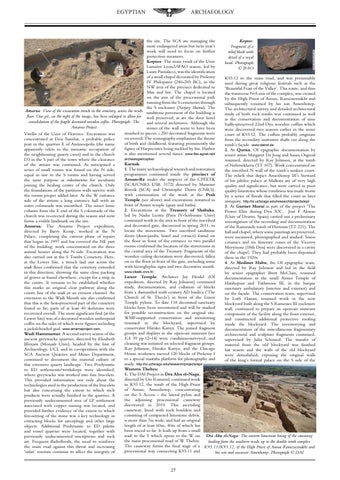
the site. The SCA are managing the Koptos: most endangered areas but next year’s Fragment of a work will need to focus on further relief block with protection measures. detail of a royal Koptos: The main result of the Univ head. Photograph Lumière Lyon2/IFAO season, led by © IFAO Laure Pantalacci, was the identification of a small chapel decorated by Ptolemy K93.12 to the main road, and was presumably IV Philopator (240-205 BC), in the used during great religious festivals such as the NW area of the precinct dedicated to ‘Beautiful Feast of the Valley’. This route, and thus Min and Isis. The chapel is located the transverse N-S axis of the complex, was created on the axis of the processional path by the High Priest of Amun, Ramessesnakht and running from the S cemeteries through subsequently resumed by his son Amenhotep. the S enclosure (Netjery Shema). The The architectural survey and detailed architectural Amarna: View of the excavation trench in the cemetery, across the wadi sandstone pavement of the building is study of both rock tombs was continued as well floor. One pit, on the right of the image, has been enlarged to allow for well preserved, as are the door lintel as the conservation and documentation of nine consolidation of the fragile decorated wooden coffin. Photograph: The and several architraves. Although the badly-preserved 22nd Dyn wooden coffins which Amarna Project stones of the wall seem to have been were discovered two seasons earlier in the inner smashed to pieces, c.250 decorated fragments were Vitelli» of the Univ of Florence. Excavation was court of K93.12. The coffins probably originate recovered. The iconography emphasizes the theme concentrated at Deir Sumbat, a probable police from the secondary instrusive shafts cut along the of birth and childhood, featuring prominently the post in the quarries E of Antinoopolis (the name tomb’s façade. www.dainst.de. figure of Harpocrates being suckled by Isis. Hathor apparently refers to the monastic occupation of 2. At Qurna, OI epigraphic documentation by is also mentioned several times. www.ifao.egnet.net/ the neighbouring quarry caves) and in the church senior artists Margaret De Jong and Susan Osgood archeologie/coptos/. D3 in the S part of the town where the clearance resumed, directed by Ray Johnson, at the tomb Karnak: of the atrium was continued. As anticipated a of Nefersekheru (TT 107). Work concentrated on 1. The many archaeological research and restoration series of small rooms was found on the N side, the inscribed N wall of the tomb’s sunken court. programmes continued inside the precinct of equal in size to the S rooms and having served The reliefs that depict Amenhotep III’s Steward Amun-Re under the auspices of the CFEETK the same purpose as enkoimeteria for incubants of his jubilee palace at Malkata are of very high (SCA/CNRS USR 3172) directed by Mansour joining the healing centre of the church. Only quality and significance, but were carved in poor Boreik (SCA) and Christophe Thiers (CNRS), the foundations of the partition walls survive with quality limestone whose condition was made worse with continuation of the work at the Ptah the rooms proper added later. At the W entrance by a series of floods that filled the court in later Temple (see above) and excavations restarted in side of the atrium a long entrance hall with an antiquity. http://oi.uchicago.edu/research/projects/epi/ front of Amun temple (quay and baths). outer colonnade was unearthed. The intact Ionic 3. At Gurnet Murai as part of the project ‘The 2. Excavations at the Treasury of Shabaka, column from the E end of the S colonnade of the Power Elite during Dyn XX’, José F Alonso led by Nadia Licitra (Paris IV-Sorbonne Univ) church was re-erected during the season and now (Univ of Deusto, Spain) carried out a preliminary continued work in the area in front of the inscribed forms a visible landmark on the site. investigation of the recording and documentation and decorated gate, discovered in spring 2011, to Amarna: The Amarna Project expedition, of the Ramesside tomb of Horimin (TT 221). The locate the storerooms. Two inscribed sandstone directed by Barry Kemp, worked at the N hall and chapel, where some paintings are preserved, doors (door-jambs, lintel and cornice) found on Palace, completing the current phase of repairs were measured, photographed and studied. Some the floor in front of the entrance to two parallel that began in 1997 and has covered the NE part ceramics and six funerary cones of the Viceroy rooms confirmed the location of the storerooms in of the building: work concentrated on the three Merymose (18th Dyn) were discovered in a cavity the central area of the Treasury. Fragments of the animal houses along the N side. Excavation was of the chapel. They had probably been deposited wooden ceiling decoration were discovered, fallen also carried out at the S Tombs Cemetery. Here, there in the 1920s. on to the floor in front of the gate, including some at the Lower Site, a trench laid out across the 4. At Medinet Habu, the OI epigraphic team, with hieroglyphic signs and two decorative motifs. wadi floor confirmed that the cemetery extended directed by Ray Johnson and led in the field www.cfeetk.cnrs.fr/. in this direction, showing the same close packing by senior epigrapher Brett McClain, resumed Luxor Temple: Architect Jay Heidel (OI of graves as found elsewhere, except for a strip in documentation in the small Amun Temple of expedition, directed by Ray Johnson) continued the centre. It remains to be established whether Hatshepsut and Tuthmosis III, in the barque study, documentation, and collation of blocks this marks an original clear pathway along the sanctuary ambulatory (interior and exterior) and from a dismantled sixth century AD basilica (‘The centre line of the wadi or an erosion channel. An on the façade. The conservation team, supervised Church of St. Thecla’) in front of the Luxor extension to the Wadi Mouth site also confirmed by Lotfi Hassan, resumed work in the new Temple pylons. To date 118 decorated sanctuary that this is the best-preserved part of the cemetery blockyard built along the S Ramesses III enclosure blocks have been inventoried and will be studied found so far; parts of at least 40 skeletons were wall, continued to prepare an open-air museum for possible reconstruction on the original site. recovered overall. The most significant find (at the component of the facility along the front exterior, WMF-supported conservation and monitoring Lower Site) was of a decorated wooden anthropoid and constructed additional protective roofing resumed in the blockyard, supervised by coffin on the sides of which were figures including inside the blockyard. The inventorying and conservator Hiroko Kariya. The joined fragment a jackal-headed god. www.amarnaproject.com. documentation of the miscellaneous fragmentary groups and displays in the open-air museum (see Wadi Hammamat: A second survey season of the architectural and sculpture fragments continued, EA 39 pp.12-14) were condition-surveyed, and ancient greywacke quarries, directed by Elizabeth supervised by Julia Schmied. The transfer of cleaning was initiated on selected fragment groups. Bloxam (Monash Univ), headed by the Inst of material from the old blockyard was finished Ray Johnson, Hiroko Kariya, and the Chicago Archaeology, UCL and in co-operation with the last season and the walls of the old blockyard House workmen moved 120 blocks of Ptolemy I SCA Ancient Quarries and Mines Department, were demolished, exposing the original walls to a special mastaba platform for photography and continued to document the material culture of of the king’s formal palace on the S side of the study. http://oi.uchicago.edu/research/projects/epi/. this extensive quarry landscape. Two Predynastic Western Thebes: to ED settlements/workshops were identified, 1. The DAI Project in Dra Abu el-Naga, where greywacke was worked into fine bracelets. directed by Ute Rummel, continued work This provided information not only about the in K93.12, the tomb of the High Priest technologies used in the production of the bracelets of Amun, Amenhotep, concentrating but also concerning the extent to which such on the S Access - the lateral pylon and products were actually finished in the quarries. A the adjoining processional causeway previously undocumented area of LP settlement discovered in 2010. This ascending associated with copper mining was located, and causeway, lined with rock boulders and provided further evidence of the extent to which consisting of compacted limestone debris, fire-setting of the stone was a key technology in is more than 7m wide, and had an original extracting blocks for sarcophagi and other large length of at least 60m, 40m of which has objects. Additional Predynastic to ED palette been traced so far. It leads up from a small and vessel quarries were located, together with wadi to the S which opens to the W on Dra Abu el-Naga: The eastern limestone lining of the causeway previously undocumented inscriptions and rock the main processional road of W Thebes. leading from the southern wadi up to the double tomb complex art. Frequent flash-floods, the need to reinforce The causeway forms the final stage of a K93.11/K93.12, of the High Priest of Amun Ramessesnakht and the main road against this threat and increasing processional way connecting K93.11 and ‘safari’ tourism continue to affect the integrity of his son and successor Amenhotep. Photograph © DAI
27