EGYPTIAN
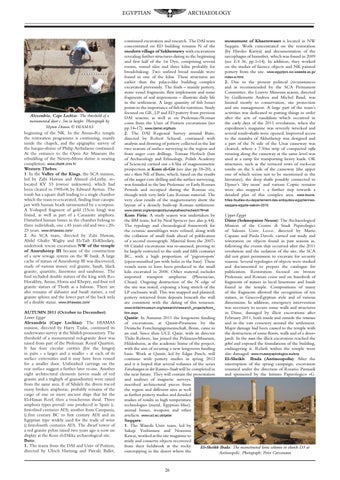
Alexandria, Cape Lochias: The threshold of a monumental door c.5m in height. Photograph by Myron Dimou © HIAMAS beginning of the NK. In the Amun-Re temple the restoration programme is continuing, mainly inside the chapels, and the epigraphic survey of the barque-shrine of Philip Arrhidaeus continued. At the entrance to the Open Air Museum the rebuilding of the Netery-Menu shrine is nearing completion. www.cfeetk.cnrs.fr/. Western Thebes: 1. In the Valley of the Kings, the SCA mission, led by Zahi Hawass and Ahmed el-Leithy, relocated KV 53 (owner unknown), which had been cleared in 1905-06 by Edward Ayrton. The tomb has a square shaft leading to a single chamber which the team re-excavated, finding four canopic jars with human heads surmounted by a scorpion. A V-shaped fragment of gold (15cm long) was found, as well as part of a Canaanite amphora. Disturbed human bones in the chamber belong to three individuals, one c.45 years old and two c.2023 years. www.drhawass.com/ 2. An SCA team, directed by Zahi Hawass, Abdel Ghafer Wagby and El-Taib El-Khodary, undertook rescue excavation NW of the temple of Amenhotep III because of the construction of a new sewage system on the W bank. A large cache of statues of Amenhotep III was discovered, made of various stones: red granite, basalt, black granite, quartzite, limestone and sandstone. The find included double statues of the king with ReHorakhty, Amun, Horus and Khepry, and four red granite statues of Thoth as a baboon. There are also remains of alabaster and basalt statues, a red granite sphinx and the lower part of the back stela of a double statue. www.drhawass.com/ AUTUMN 2011 (October to December) Lower Egypt Alexandria (Cape Lochias): The HIAMAS mission, directed by Harry Tzalas, continued its underwater survey at the Silsileh promontory. The threshold of a monumental red-granite door was raised from part of the Ptolemaic Royal Quarters. It has four circular cavities (for the hinges) in pairs - a larger and a smaller - at each of its surface extremities and it may have been reused for a smaller door. Unfinished carvings on the rear surface suggest a further later re-use. Another eight architectural elements (seven made of red granite and a triglyph of granodiorite) were raised from the same area. E of Silsileh the divers traced many broken amphorae, probably remains of the cargo of one or more ancient ships that hit the El-Hassan Reef, then a treacherous shoal. Three amphora types prevail: one produced in Spain (c. first-third centuries AD); another from Campania, (c.first century BC to first century AD) and an Egyptian type widely used for the trade of wine (c.first-fourth centuries AD). The dwarf tower of a red granite pylon raised two years ago is now on display at the Kom el-Dikka archaeological site. Buto: 1. The teams from the DAI and Univ of Poitiers, directed by Ulrich Hartung and Pascale Ballet,
ARCHAEOLOGY
continued excavation and research. The DAI team concentrated on ED building remains N of the modern village of Sekhemawy with excavations revealing further structures dating to the beginning and first half of the 1st Dyn, comprising several rooms, round silos and three kilns probably for bread-baking. Two unfired bread moulds were found in one of the kilns. These structures are earlier than the palace-like building complex excavated previously. The finds – mainly pottery, stone vessel fragments, flint implements and some fragments of seal impressions – illustrate daily life in the settlement. A large quantity of fish bones points to the importance of fish for nutrition. Study focused on GR, LP and ED pottery from previous DAI seasons, as well as on Ptolemaic/Roman coins from the Univ of Poitiers excavations (see pp.14-17). www.dainst.org/buto. 2. The DAI Regional Survey around Buto, directed by Robert Schiestl, continued with analysis and drawing of pottery collected in the last two seasons of surface surveying in the region and from auger core drillings. Tomasz Herbich (Inst of Archaeology and Ethnology, Polish Academy of Sciences) carried out c.4.5ha of magnetometric prospection at Kom el-Gir (see also pp.18-20), a site c.4km NE of Buto, which, based on the results of the auger core drilling and the surface surveying, was founded in the late Ptolemaic or Early Roman Periods and occupied during the Roman era, though with very little Late Roman material. The very clear results of the magnetometry show the layout of a densely built-up Roman settlement.
monument of Khaemwaset is located in NW Saqqara. Work concentrated on the restoration (by Hiroko Kariya) and documentation of the sarcophagus of Isisnofret, which was found in 2009 (see EA 36, pp.1-14). In addition, they worked on the studies of faience objects and NK painted pottery from the site. www.egyptpro.sci.waseda.ac.jp/ index-e.html.
2. Due to the present political circumstances and as recommended by the SCA Permanent Committee, the Louvre Museum season, directed by Guillemette Andreu and Michel Baud, was limited mostly to conservation, site protection and site management. A large part of the team’s activities was dedicated to putting things in order after the acts of vandalism which occurred in the early days of the 2011 revolution, when the expedition’s magazine was severely wrecked and several tomb-shafts were opened. Improved access to the mastaba of Akhethetep was designed and a part of the N side of the Unas causeway was cleaned, where a 7.50m strip of compacted tafla running along the causeway at the same level was used as a ramp for transporting heavy loads. OK structures, such as the terraced rows of rock-cut tombs on the S side of the causeway (the upper one of which seems not to be mentioned in the literature), the deep shafts possibly connected to Djoser’s ‘dry moat’ and various Coptic remains were also mapped - a further step towards a detailed plan of this complex area. www.louvre. fr/les-fouilles-du-departement-des-antiquites-egyptiennessaqqara-egypte-saison-2010.
www.dainst.org/en/project/surveykafreschscheich?ft=all.
Kom Firin: A study season was undertaken by the BM team, led by Neal Spencer (see also p.44). The typology and chronological framework for the ceramic assemblages were refined, along with the collation of small finds ahead of publication of a second monograph. Material from the 200708 Citadel excavations was re-assessed, proving to be largely restricted to the sixth and fifth centuries BC, with a high proportion of ‘pigeon-pots’ (open-mouthed jars with holes in the base). These vessels seem to have been produced in the small kiln excavated in 2008. Other material includes imported transport amphorae (Phoenician, Chian). Ongoing destruction of the N edge of the site was noted, exposing a long stretch of the LP enclosure wall. This was mapped and planned; pottery retrieved from deposits beneath the wall are consistent with the dating of this temenos. www.britishmuseum.org/research/research_projects/kom_ firin.aspx.
Upper Egypt Dime (Soknopaiou Nesos): The Archaeological Mission of the Centro di Studi Papirologici of Salento Univ, Lecce, directed by Mario Capasso and Paola Davoli, carried out study and restoration on objects found in past seasons as, following the events that occurred after the 2011 revolution and the isolation of the site, the SCA did not grant permission to excavate for security reasons. Several typologies of objects were studied and documented to prepare the catalogue for publication. Restoration focused on bronze Ptolemaic and Roman coins and on hundreds of fragments of statues in local limestone and basalt found in the temple. Compositions of many of the fragments allowed the recognition of ten statues, in Graeco-Egyptian style and of various dimensions. In addition, emergency intervention was necessary to secure some walls and structures in Dime, damaged by illicit excavations after February 2011, both inside and outside the temenos and in the vast cemetery around the settlement. Major damage had been caused to the temple with the destruction of some floors, walls and of a doorjamb. In the naos the illicit excavation reached the gebel and exposed the foundations of the building, endangering it. Reliefs within the temple were also damaged. www.museopapirologico.eu/snp El-Sheikh Ibada (Antinoopolis): After the interruption of the spring campaign, excavation resumed under the direction of Rosario Pintaudi and sponsored by the Istituto Papirologico «G.
Qantir: In Autumn 2011 the long-term funding of excavations, at Qantir-Piramesse by the Deutsche Forschungsgemeinschaft, Bonn, came to an end. Since then UCL Qatar, with its director Thilo Rehren, has joined the Pelizaeus-Museum, Hildesheim, as the academic home of the project, with the aim of securing a new long-term funding basis. Work at Qantir, led by Edgar Pusch, will continue with pottery studies in spring 2012 and it is hoped that several volumes of the series Forschungen in der Ramses-Stadt will be completed in the near future. They will contain the presentation and analyses of magnetic surveys, inscribed architectural pieces from the region and different sites as well as further pottery studies and detailed studies of results in high temperature technologies (metal, Egyptian blue), animal bones, weapons and other artefacts. www.ucl.ac.uk/qatar. Saqqara: 1. The Waseda Univ team, led by Sakuji Yoshimura and Nozomu Kawai, worked at the site magazine to study and conserve objects recovered from their fieldwork at the rocky El-Sheikh Ibada: The reconstructed Ionic column in church D3 at outcropping in the desert where the Antinoopolis. Photograph: Peter Grossmann
26