EGYPTIAN
ARCHAEOLOGY
boy’s introduction to the god Imsety. From the tomb of the prince’s brother, Khaemwaset, he painted a similar scene and an image of the god Osiris. His eye was also caught by a scene from the tomb of the Deir el-Medina artisan Pashedu which shows the tomb owner bending down to take a sip of water in the shade of a luscious palm tree against a backdrop of crisp black hieroglyphs. He also made a copy of the famous scene of a priest with an Anubis mask leaning over the mummified body of Sennedjem, another inhabitant of Deir el-Medina. From the tomb of Djeserkaresoneb, he painted three scenes variously depicting the official’s duties as well as his preparations for the life to come. Campbell’s imagination seems to have been especially captured by the tomb of Menna, from which he painted five complete scenes, three of which represent the entirety of the inner chapel – the facsimiles of its long walls are each over 6m in length. Perhaps he sympathised with the damage inflicted on Menna’s eyes by some ancient vandal, rendering him unable to see the splendours of his own walls - in his publication of the tomb, Campbell noted the pain of ‘watching without being able to see’. Campbell made no notes that have so far come to light on his techniques. However, clues are present in the paintings themselves. Working on thick paper, Campbell seems to have first drafted in pencil, and then applied paint on top of his sketched outlines. The very large paintings were managed by patchworking cut-out paper panels on to a cotton fabric background. Some of his notes on colours and textures survive on the fronts and backs of the paintings and all are marked with his distinctive signature. From the high degree of accuracy, it seems likely that he spent a great deal of time working in the tombs themselves. The First World War may have put an end to Campbell’s trips to Egypt, but he did not give up his passion for Egyptology. Between 1916 and 1922, as Gunning Lecturer for two consecutive terms, he gave a series of well-received talks on Egyptological subjects at Edinburgh University. The final lectures in the series were devoted to the Egyptian afterlife.
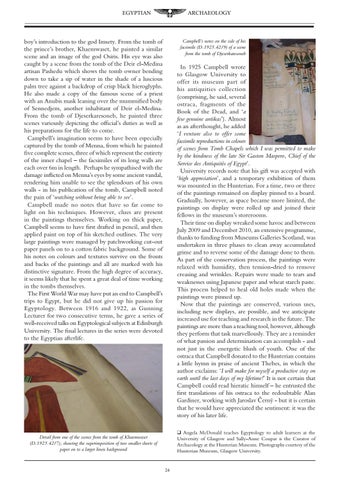
Campbell’s notes on the side of his facsimile (D.1925.42/9) of a scene from the tomb of Djeserkaresoneb
In 1925 Campbell wrote to Glasgow University to offer its museum part of his antiquities collection (comprising, he said, several ostraca, fragments of the Book of the Dead, and ‘a few genuine antikas’). Almost as an afterthought, he added ‘I venture also to offer some facsimile reproductions in colours of scenes from Tomb Chapels which I was permitted to make by the kindness of the late Sir Gaston Maspero, Chief of the Service des Antiquités of Egypt’. University records note that his gift was accepted with ‘high appreciation’, and a temporary exhibition of them was mounted in the Hunterian. For a time, two or three of the paintings remained on display pinned to a board. Gradually, however, as space became more limited, the paintings on display were rolled up and joined their fellows in the museum’s storerooms. Their time on display wreaked some havoc and between July 2009 and December 2010, an extensive programme, thanks to funding from Museums Galleries Scotland, was undertaken in three phases to clean away accumulated grime and to reverse some of the damage done to them. As part of the conservation process, the paintings were relaxed with humidity, then tension-dried to remove creasing and wrinkles. Repairs were made to tears and weaknesses using Japanese paper and wheat starch paste. This process helped to heal old holes made when the paintings were pinned up. Now that the paintings are conserved, various uses, including new displays, are possible, and we anticipate increased use for teaching and research in the future. The paintings are more than a teaching tool, however, although they perform that task marvellously. They are a reminder of what passion and determination can accomplish - and not just in the energetic blush of youth. One of the ostraca that Campbell donated to the Hunterian contains a little hymn in praise of ancient Thebes, in which the author exclaims: ‘I will make for myself a productive stay on earth until the last days of my lifetime!’ It is not certain that Campbell could read hieratic himself – he entrusted the first translations of his ostraca to the redoubtable Alan Gardiner, working with Jaroslav Černý - but it is certain that he would have appreciated the sentiment: it was the story of his later life. q Angela McDonald teaches Egyptology to adult learners at the University of Glasgow and Sally-Anne Coupar is the Curator of Archaeology at the Hunterian Museum. Photographs courtesy of the Hunterian Museum, Glasgow University.
Detail from one of the scenes from the tomb of Khaemwaset (D.1925.42/7), showing the superimposition of two smaller sheets of paper on to a larger linen background
24