EGYPTIAN
ARCHAEOLOGY
The Egyptological afterlife of Colin Campbell Colin Campbell made his name with early publications of celebrated Theban tombs, but his facsimile paintings from some of them are largely unknown. Angela McDonald and Sally-Anne Coupar have been working to conserve the paintings and to uncover the history behind them. Three years ago, while foraging through the collection of Glasgow University’s Hunterian Museum to identify items that might inspire students, we came across a series of thirteen facsimile paintings that had been quietly gathering dust in storage. The name of the artist – the Reverend Colin Campbell – was immediately familiar as the author of several important studies, including a critical re-appraisal of a contemporary publication of the tomb of Nefertari (1909), the first – and until recently, only – detailed description of the scenes and texts in Menna’s tomb (1910), and a pioneering photographic publication of the complex divine birth scenes in Luxor Temple (1912). However, so far as we knew, his collection of paintings was relatively unknown. Attracted by the paintings’ vivacity, we decided to make them the focus of a summer lecture in Glasgow in 2009. The lecture, which culminated in a dramatic unrolling of three of the paintings, excited a lot of interest, not only in the Theban tomb scenes, captured life-size and in colour on the canvases, but also in the artist himself. We were asked about how Campbell had managed to make his paintings, what materials he had used, whether he had worked in the tombs themselves, where he had studied Egyptology (never an easy task in Scotland!), and so on. Since the paintings were in a rather fragile state, we decided that conservation should be a priority, but we also wanted a better understanding of the man behind them who, after an illustrious ecclesiastical career, had re-fashioned himself into an Egyptologist. Born in Campbeltown, Argyllshire, in 1848, Colin Campbell was the son of a local tailor. He quickly distinguished himself as a student at Glasgow University, winning some 35 academic prizes for compositions, oral readings from Latin and Greek, and performance
Colin Campbell in 1889. Courtesy of the Local History Centre, Dundee Central Library
in examinations. After completing his Masters degree in 1874, he went on to obtain a Bachelor’s degree in divinity, and at the age of 30 he took up his first position as minister of St Mary’s church in Partick, Glasgow. Four years later he moved north to another St Mary’s, in Dundee, where he spent the remainder of his ecclesiastical career, occasionally moonlighting to preach at Crathie Parish Church on the Balmoral estate where his sermons were greatly enjoyed by Queen Victoria. Ill health forced his retirement in 1904. Although this was the end of one chapter of his life, it was also the beginning of another. It was as an undergraduate at Glasgow University that Campbell was first introduced to ancient Egypt by Edmund Law Lushington, a Professor of Greek who later became the University’s Rector and gave his inaugural address on the wars of Ramesses II. But it was an interest in Egyptian religion in particular that he instilled in Campbell. This was an interest Campbell began to indulge fully one year after his retirement, when he made his first trip to Egypt. Coming across a loose block in the Temple of Luxor inscribed with the distinctive, distorted face of the heretic king Akhenaten, he immediately recognised the significance of his find, and published it in The Proceedings of the Society of Biblical Archaeology the following year. Thus began his passion not only to discover Egypt for himself but to share his findings. He returned to Luxor for eight successive winters, initially probably for his health but latterly to soak up the art and atmosphere of the past. Steadily, Campbell published descriptions of six Theban tombs that particularly appealed to him. From the time of his first visit, perhaps for his own pleasure, he had been making facsimiles of his favourite scenes, starting with an amalgamation of images from the tomb of Ramesses III’s young son Amenherkhepeshef that showed the
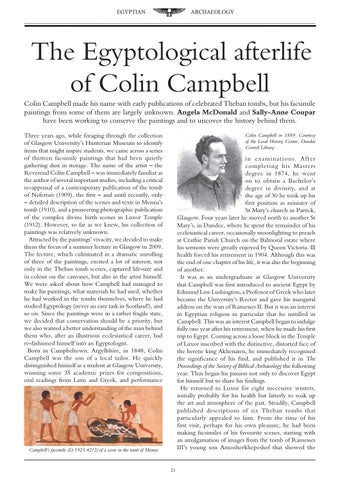
Campbell’s facsimile (D.1925.42/2) of a scene in the tomb of Menna
21